

Case #024 - 🚨 Amazon accepted an invalid variation grouping
A preventative categorization fix on one child ASIN closed without incident. Then the seller noticed a child that had never been part of the family at all.

If you’re new here, welcome.
If you’ve been reading for a while, thank you for being here.
Each week, we break down one real Amazon case from the field. Not to share tactics, but to decode how Amazon’s system actually behaves and what to do when it breaks.
All past cases live in a single searchable archive, built to help you identify recurring patterns across time.

Context
A preventive categorization correction exposed a deeper variation issue
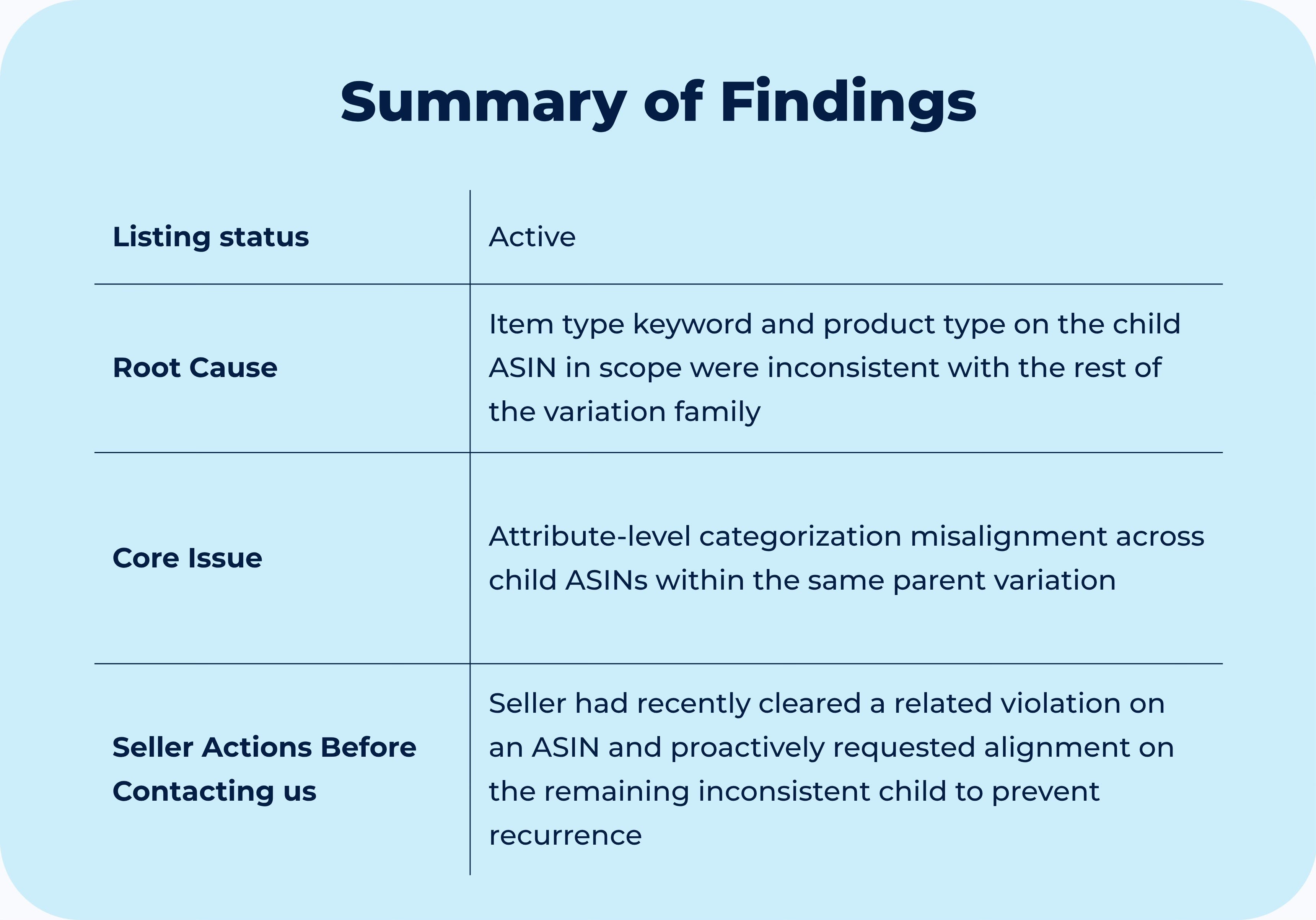
The seller had recently resolved an Invalid Variation Grouping violation on a child ASIN, a situation that predated our involvement.
Once that situation was behind them, their attention focused on other child ASINs within the same variation family that carried categorization inconsistencies.
Luckily, there was no active suppression, no open enforcement action, and no immediate consequence.
The correction was initiated as a preventive measure, with the expectation that aligning categorization attributes across all children would reduce the risk of a future violation similar to the one that had already occurred.
The seller’s logic was straightforward: if one child had already triggered a violation due to categorization inconsistencies, leaving other misaligned children unchanged would create the same exposure elsewhere in the variation.
What nobody anticipated was that completing the correction would prompt the seller to look more closely at the variation family as a whole and, in doing so, discover a structural gap unrelated to the categorization work itself.
Diagnostic
Amazon can accept an invalid variation and flag it later
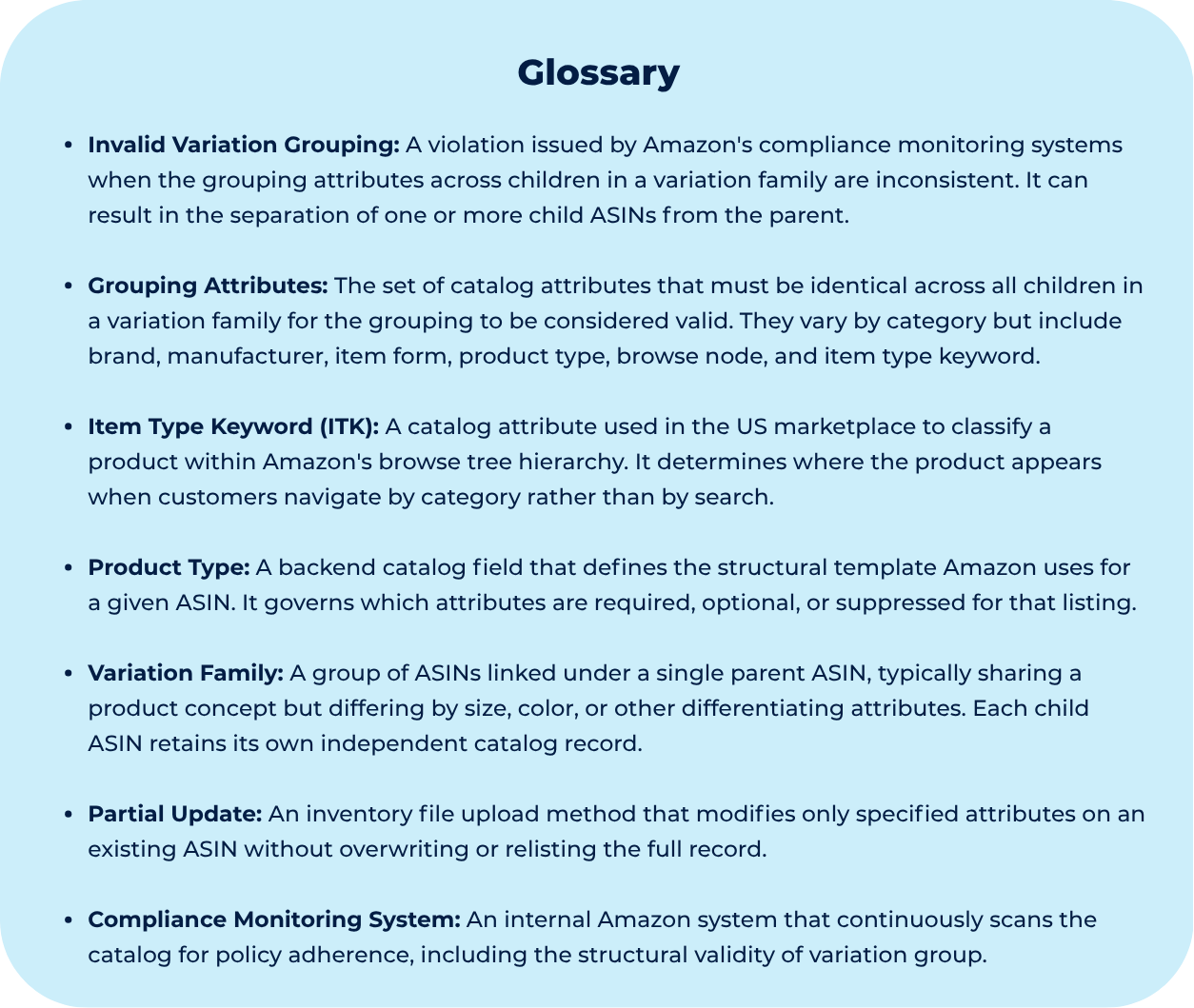
To understand this case, you must first know that Amazon’s catalog allows variation families to be created through inventory file uploads, the system applies validation at the moment of upload but the validation process doesn’t always align with the logic, making the whole system imperfect.
Even more important, a variation with inconsistent grouping attributes can pass the initial check and go live, so the listing appears active, the parent-child relationship displays on the detail page, and, from the seller’s view, the structure looks correct.
While in the background, compliance monitoring systems continuously scan the catalog against a stricter standard.
These systems evaluate grouping attributes across all children in a variation family and verify that they are identical.
The attributes that determine whether a grouping is valid vary by category, but they include:
Brand
Manufacturer
Item form
Categorization attributes, specifically: product type, browse node, and item type keyword
But when an inconsistency is detected, the system can separate the variation and issue a violation, even if the original upload was accepted without error.
This is what produced the prior violation on one of the child ASINs: the variation was created with inconsistent categorization attributes, the upload passed, and the compliance monitoring caught it afterward.
The child ASIN in scope for this project was in the same structural position, part of a live variation, but carrying different categorization attributes than its siblings.
If you are managing a variation family in which children may carry inconsistent categorization attributes, or if you have received an Invalid Variation Grouping violation. Contact Online Seller Solutions.
Though Process
Correcting the categorization without breaking the variation
The scope of this case was narrow from the start: two child ASINs carried categorization attributes that did not match the rest of the variation family.
The question was not whether the inconsistency existed, but how to correct it without introducing a new structural issue in the process.
The first judgment call was deciding where the correction should occur.
Changing categorization attributes is no longer as straightforward as submitting a catalog contribution. In many cases, those attributes are controlled by Amazon’s internal catalog systems, meaning the challenge is often obtaining approval for the correction rather than identifying the correct values.
That made it important to distinguish between a categorization problem and a variation problem.
Before selecting the correction method, the inconsistent attributes had to be confirmed with precision, and there were four ways to obtain that data. If you read the Case #019 solution, you will see that those steps are used to retrieve the data, which often determines whether a case moves forward or stalls at the diagnostic stage.
The second judgment call came after the correction was confirmed.
The seller flagged a separate ASIN as missing from the variation family and assumed the work had caused its absence, but before any further action was considered, the first step was to verify whether that ASIN had ever been part of the family.
It had not, so the gap was pre-existing, and adding it to the variation required its own evaluation, separate from the work already completed.
