

Case #007 - Restricted by a Claim on a Virtual ASIN
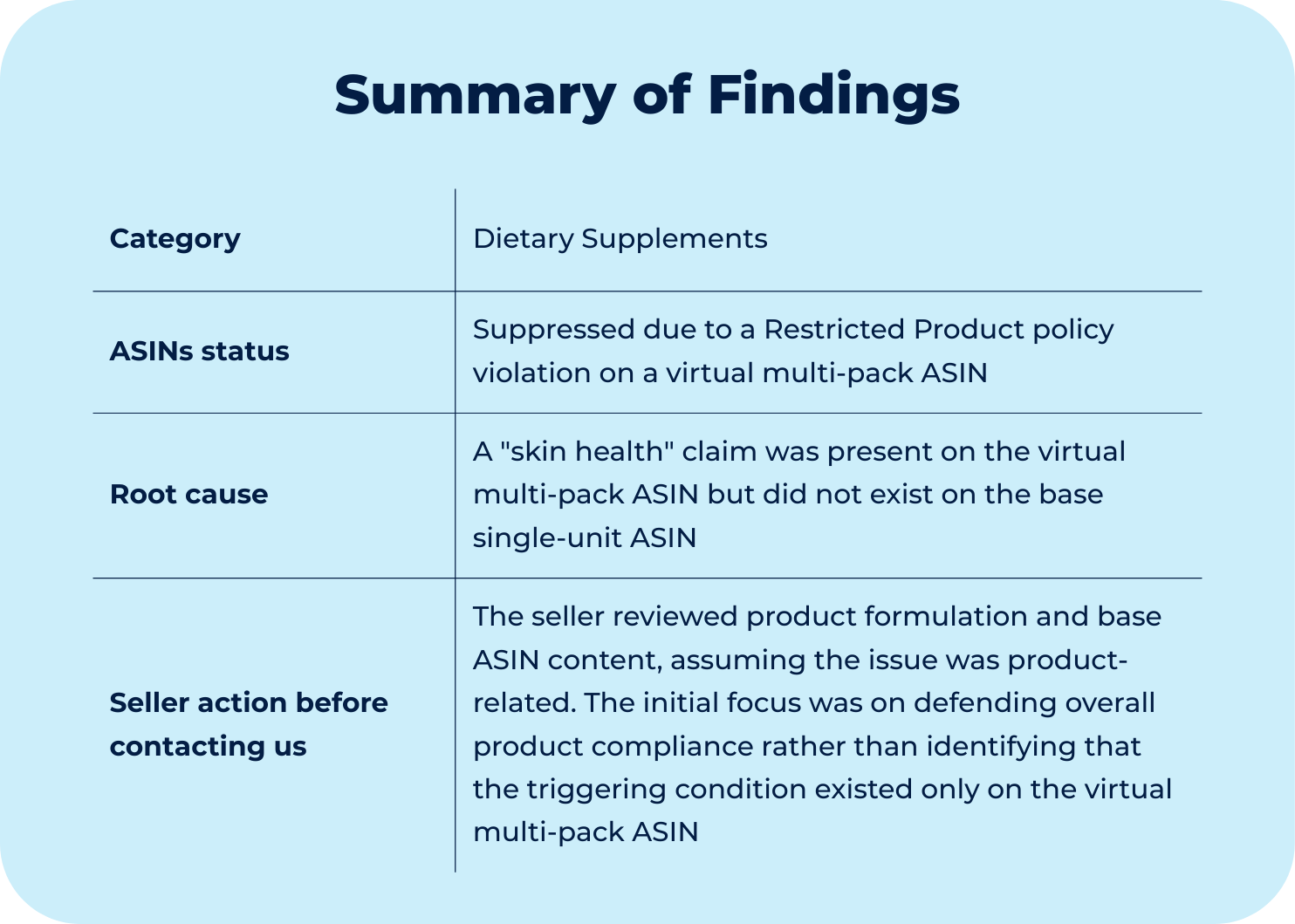
A virtual multi-pack was restricted for a dietary supplement claim that didn't exist on the base product.

If you’re new here, welcome.
If you’ve been reading for a while, thank you for being here.
Each week, we break down one real Amazon case from the field. Not to share tactics, but to decode how Amazon’s system actually behaves and what to do when it breaks.
All past cases live in a single searchable archive, built to help you identify recurring patterns across time.

Context
A restriction triggered by a virtual multi-pack
The client’s account received a Restricted Product policy violation on one of their ASINs.
The ASIN was a virtual multi-pack (Pack of 2), created at the catalog level, not a physical bundle.
The product was active and selling when the restriction was applied. No warnings preceded it. The ASIN was suppressed directly under “Restricted Products.” And it is worth mentioning that there were no contribution done by data augmenters.
Amazon’s instructions in Seller Central focused on content, not formulation or safety documentation. The notification specified that a “skin health” claim needed to be removed from the bullet points and product description.
The flagged claim appeared on the virtual multi-pack ASIN only, not on the single-unit ASIN used as the base product.
The question became: why was a virtual ASIN, derived from an otherwise compliant product, evaluated independently and restricted?
Diagnostic
How Amazon evaluated the virtual ASIN
The restriction was triggered by ASIN-level content evaluation. Amazon evaluated the virtual multi-pack as an independent catalog entity. Virtual multi-packs do not inherit compliance status from the base ASIN. Each ASIN is assessed on its own detail page content and protected attributes.
Three facts explain the restriction:
Virtual multi-pack ASINs are evaluated independently:
Amazon treats virtual multi-packs as standalone ASINs with their own descriptive content. They are reviewed independently under the Restricted Products policy. Compliance on the single-unit ASIN does not extend to virtual ASINs.
Restricted Products enforcement is driven by content triggers:
The violation was content-based. Amazon identified a “skin health” claim in the bullet points and product description of the virtual ASIN. No issues were raised regarding ingredients, formulation, safety documentation, or labeling.
Dietary supplement claims are evaluated narrowly and literally:
Under Amazon’s Dietary Supplements policy, claims that imply health outcomes are treated as high risk. When such claims appear in content fields, the system evaluates them at face value. The presence of the claim alone triggers restriction, regardless of intent or context.
The restriction resulted from ASIN-scoped content evaluation on a virtual catalog entity, not from a product-level compliance failure.
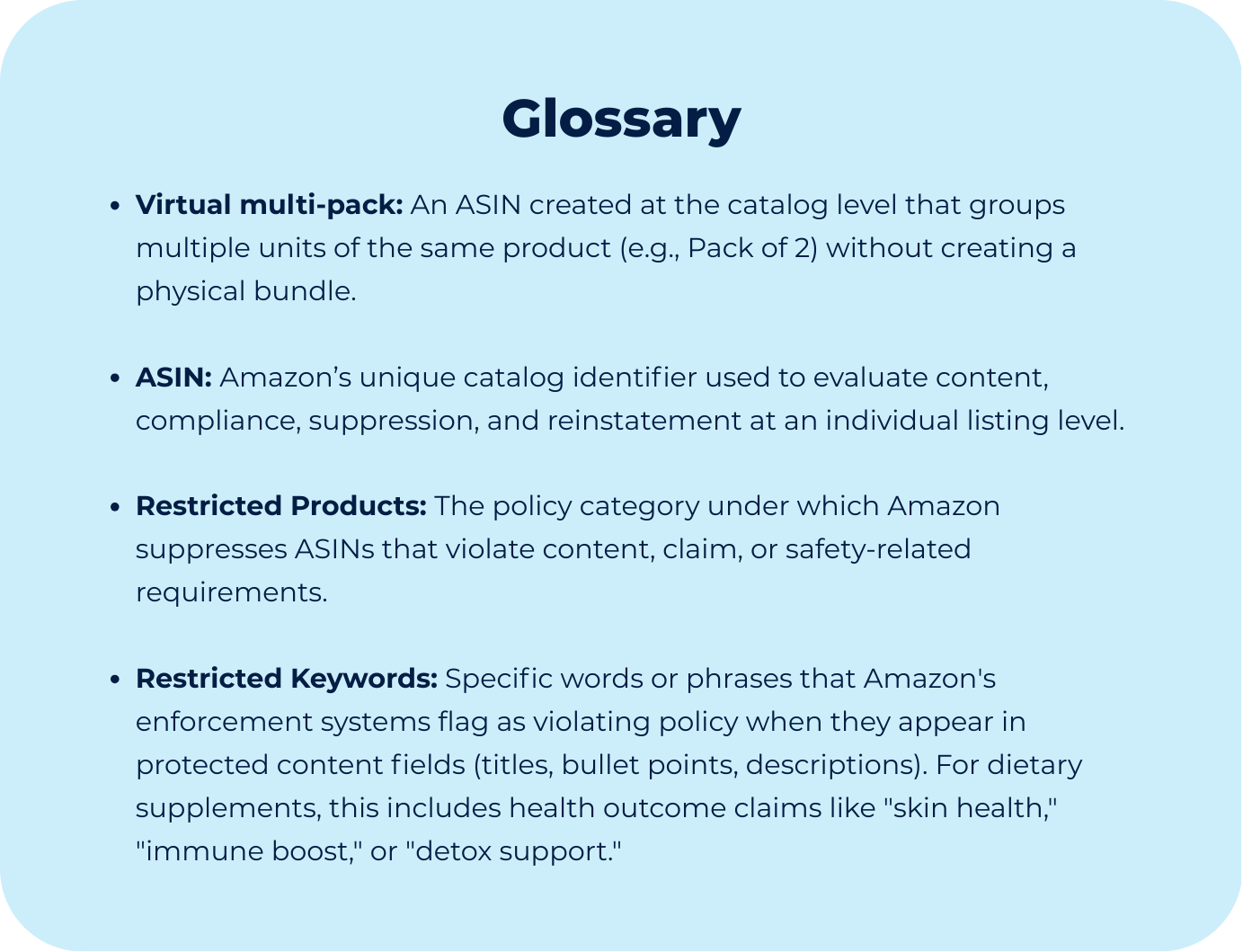
Here is a list of restricted claim language that you must avoid to prevent suppression.
In cases like this, most sellers waste weeks defending formulation when the system is only evaluating content.
When Amazon flags a virtual ASIN independently, identifying which ASIN holds the triggering condition first prevents repeated appeals that the system is built to reject.
Though Process
Why removing one claim wasn’t enough to guarantee reinstatement
When Amazon flags content for policy violations, the natural response is to fix what they explicitly mention and move on. But that approach assumes Amazon’s notice represents the full extent of the compliance issue. In reality, the notice only confirms which specific trigger caused the system to act, not whether other violations exist or whether the fix will be sufficient for reinstatement.
This creates a strategic question: do you address only what Amazon flagged, or do you treat the flag as a signal that the entire listing needs review?
Insight #1: Amazon’s enforcement systems evaluate surfaces, not intentions
Amazon’s compliance infrastructure doesn’t operate on a violation-by-violation basis where each flag is resolved in isolation. The systems evaluate ASINs against policy frameworks that span multiple attributes simultaneously. When one claim triggers a restriction, it means the system was scanning that ASIN, making the system solely focus on that specific trigger.
The risk isn’t just the flagged claim. It’s that other restricted language that exists elsewhere in the listing, waiting to be caught in the next review cycle. If you fix only what Amazon mentioned and resubmit, you’re betting that nothing else will trigger on re-evaluation.
This is why reactive fixes often lead to multiple rejections. The catalog state keeps failing because the correction was scoped too narrowly.
Insight #2: Restricted language operates across policy boundaries
Dietary supplement restrictions aren’t isolated from other enforcement categories. A phrase that seems compliant under one framework can still cross into drug claims, disease treatment language, or unapproved health outcomes under another.
An ASIN can be compliant with supplement policy but still trigger on pesticide language, medical device claims, or even cosmetic drug definitions if the wording implies therapeutic effect.
That means compliance isn’t just about removing supplement-specific triggers. It’s about ensuring no language anywhere in the listing can be classified as restricted under any adjacent policy Amazon enforces.
Insight #3: Text compliance and visual compliance are evaluated together
Amazon’s reviewers don’t just read listing content in isolation. They cross-reference what’s written against what’s shown. If the text claims one thing and the images suggest another, or if the images are incomplete and don’t provide visual verification of the product’s physical state, the appeal can be rejected even if the text is now clean.
This means that content correction alone doesn’t guarantee reinstatement. The visual layer has to support the compliance claim. If Amazon can’t independently verify that the listing accurately represents the product through imagery, they may treat the appeal as unsubstantiated.
Insight #4: Virtual Bundles are evaluated independently, even when you control the content
The violation occurred on a virtual multi-pack, not the base single-unit ASIN. Although the seller had created this virtual ASIN and controlled its content, Amazon’s enforcement systems still evaluated it as a completely separate catalog entity.
This independence matters because it means compliance isn’t inherited. Even when two ASINs represent the same physical product and are managed by the same seller, Amazon evaluates each one against policy frameworks separately. A base ASIN can be perfectly compliant while its virtual multi-pack triggers a restriction, or vice versa.
That independence creates a diagnostic principle: when a violation occurs on any ASIN in a product family, the first question isn’t “is the product compliant,” but “which ASIN is non-compliant, and does the triggering content exist elsewhere?”
In seller-controlled cases like this one, the fix is straightforward: correct the content on the flagged ASIN. But in hybrid scenarios where Amazon or other contributors populate fields, resolution can require escalation to clarify attribution and establish edit authority.
So the takeaway isn’t “avoid virtual ASINs.” It’s “understand that every ASIN you create or manage is independently evaluable, and each one requires its own compliance verification.”
