

Case #006 - The Myth of Global Variations on Amazon
A variation that worked in the US failed in the UK, revealing why Amazon treats parent ASINs as marketplace-specific structures.


If you’re new here, welcome.
If you’ve been reading for a while, thank you for being here.
Each week, we break down one real Amazon case from the field. Not to share tactics, but to decode how Amazon’s system actually behaves and what to do when it breaks.
All past cases live in a single searchable archive, built to help you identify recurring patterns across time.
Context
When creating a variation exposes problems that don’t live in the variation
A seller wanted to create a parent–child variation in both the US and UK marketplaces using two existing ASINs. The products were related correctly, already active, and selling in each marketplace.
From the seller’s perspective, this was expected to be a straightforward catalog task. The ASINs already existed, there were no policy issues, and the work appeared limited to standard variation creation, most likely through a flat file.
The request became more nuanced when the seller asked a critical question:
“If we create the variation in the US, will it automatically take effect in the UK?”
The assumption was reasonable. The ASINs had been originally created in the US, and the seller expected that once the relationship was established there, Amazon would replicate the structure in the UK marketplace.
With that expectation in mind, the decision was made to focus on the UK catalog, where the relationship did not yet exist and where the seller expected Amazon to replicate the same structure once the variation was built in the US.
However, when attempting to create the variation in the UK marketplace, the process failed. The catalog did not accept the relationship, and the variation could not be generated, despite the products appearing compatible from a seller-facing perspective.
What initially looked like a simple variation setup turned into a deeper catalog issue, raising a more important question: why could two active, related ASINs be successfully grouped in one marketplace, but not in another?
Diagnostic
Why the variation could not exist in the UK catalog
The failure did not occur at the variation level. It occurred before Amazon ever evaluated the parent–child structure.
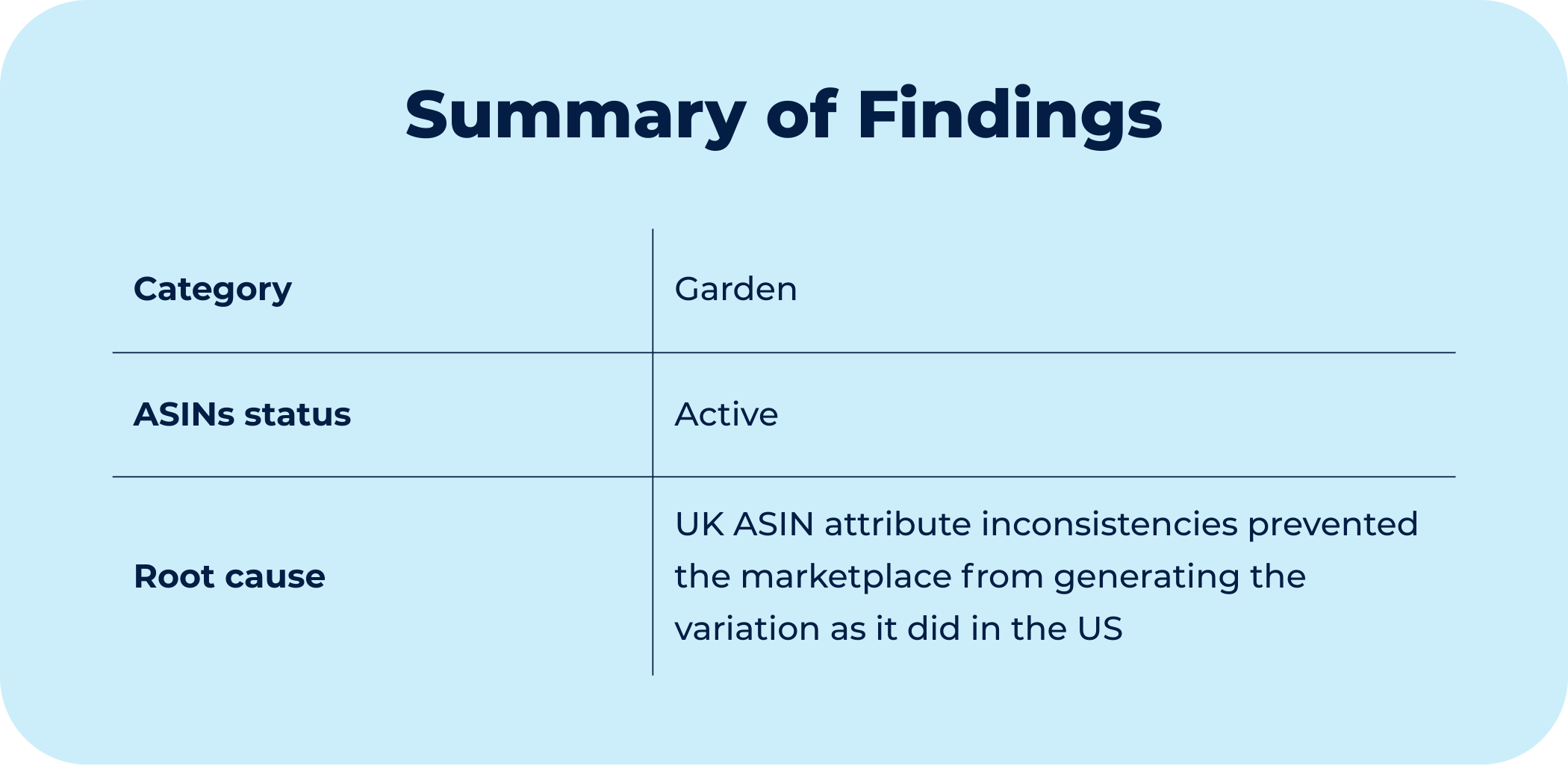
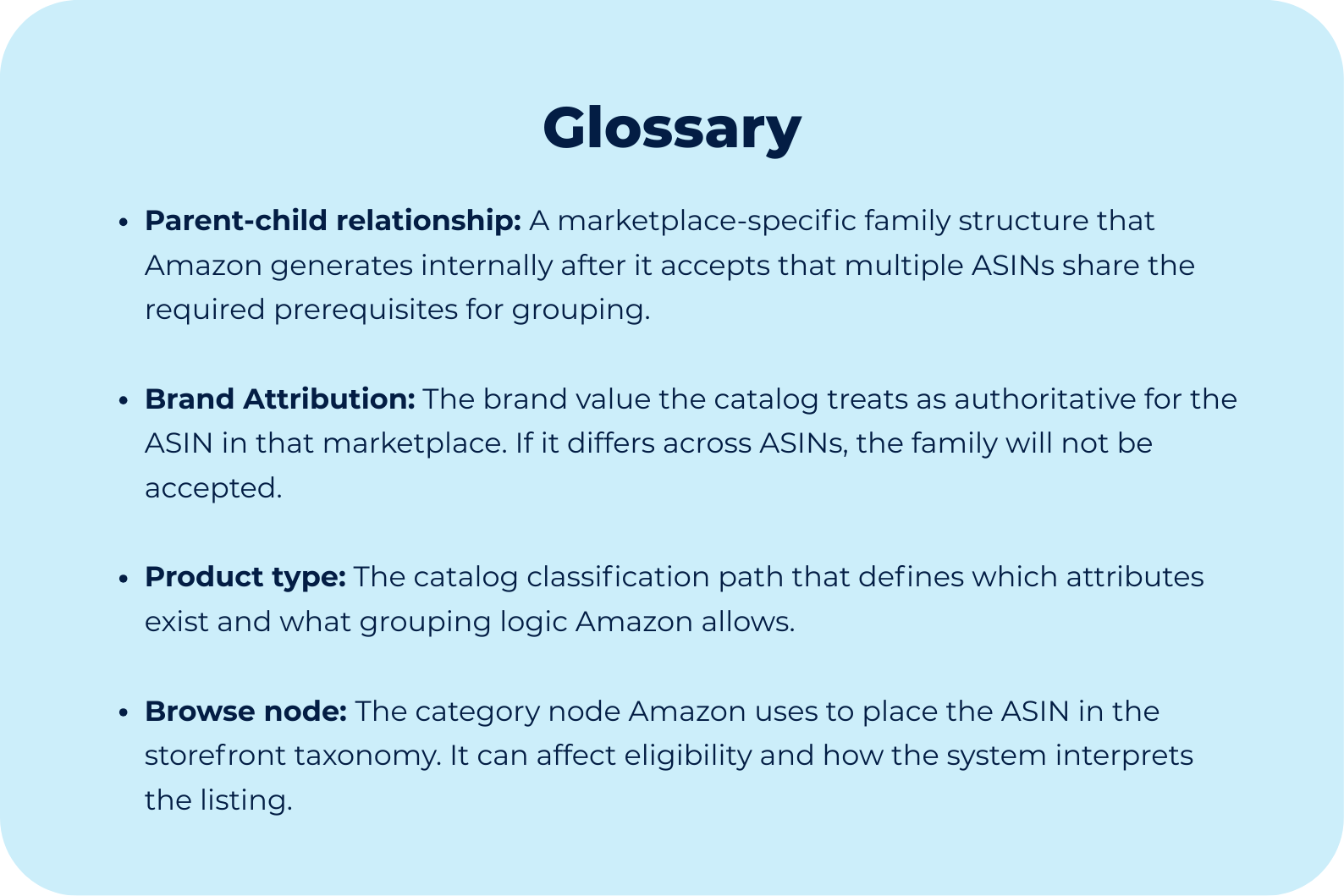
In the UK marketplace, Amazon’s catalog rejected the eligibility of the two ASINs to belong to the same family. A variation can only be generated after the marketplace catalog accepts that multiple ASINs meet all prerequisite conditions. In this case, the UK catalog never reached that stage.
The primary blocking issue was Brand Attribution. The ASINs did not share the same brand name in the UK as they did in the US.
Although the products appeared related from a seller-facing perspective, the two ASINs did not share the same authoritative brand value in the UK catalog layer. The brand name is a gating attribute for variation creation. If the brand name does not match exactly across ASINs, the marketplace will not generate a parent–child relationship, regardless of how similar the products are.
Two factors compounded this problem:
Amazon did not disclose who was contributing to the brand name in the UK.
The seller did not have direct authority to overwrite the brand through normal listing edits.
As a result, the UK catalog did not recognize the ASINs as belonging to the same brand, and the relationship was rejected upstream.
Beyond brand, the catalog foundation was also misaligned. The ASINs did not fully match in product type and browse node, which defines the category path Amazon uses to determine structural compatibility. Variations require products to live under the same catalog path. If that alignment is missing, Amazon will not consider the ASINs eligible to be grouped.
These fields are not fully controlled by the seller. Amazon assigns and validates product type and category automatically based on listing signals such as images, bullet points, descriptions, historical data, and backend classification logic. Even when a seller successfully updates a category, Amazon may later override it if the system determines the product belongs elsewhere.
This explains why category fixes sometimes appear to work temporarily and then revert. The system is not failing. It is reassessing and reclassifying based on its internal confidence model.
The diagnostic conclusion was that the UK marketplace was structurally ineligible to generate the parent–child variation. Until the brand name and the catalog path were fully aligned, the UK catalog correctly refused to create the relationship.
In cases like this, the hardest part is rarely the fix itself. It’s knowing where the problem actually lives before you start retrying actions that the system is designed to ignore.
When catalog behavior doesn’t match Amazon’s recommendations, finding the best way to clarify ownership and eligibility first often saves a lot of unnecessary retries.
Though Process
How we avoided forcing the variation
At this point, the objective was no longer to “make the variation work,” but to understand why the UK catalog was refusing to even consider it. Trying to force structure before answering that question would have guaranteed repeated failure.
Insight #1: Do not try to mirror the structure of another marketplace.
The easiest mistake would have been to build the variation where it was simple, then push the same structure into the UK using the same file and expect the UK catalog to “catch up.” That approach usually burns time because Amazon does not treat marketplace catalogs as replicas. Each marketplace validates catalog structures independently, even when ASINs originate from the same source.
Insight #2: Identify what attributes were misaligned.
Instead of asking, “What flat file do we need?” we asked a different question: what is the UK catalog rejecting?
From there, we worked through the eligibility gates in the same order Amazon evaluates them:
Brand
Product type
Brand came first because it is a hard blocker. If the brand is not accepted as identical across ASINs, nothing else matters. The catalog will not proceed to evaluate the structure if brand attribution fails.
Insight #3: Separate what can be changed manually from what cannot.
Some fields behave like normal, editable listing content. Others required a higher catalog authority from Amazon. Brand, product type, and browse node fall into this second category. These fields define catalog eligibility, which is why they are not so easy to edit. Treating them like regular editable attributes leads to repeated failure because the system evaluates them before any variation logic is applied.
Insight #4: Define when to escalate and to which team.
Once it was clear the seller could not directly correct the UK brand value, escalation was no longer optional. The only viable path forward was to route the issue through the appropriate internal catalog path, supported by evidence demonstrating the correct brand attribution and catalog foundation.
At that point, the variation itself stopped being the problem. The real work was ensuring the UK catalog was structurally ready to accept it.
