

Case #033 - 🔒 Amazon reinstated the ASIN but kept the inventory locked
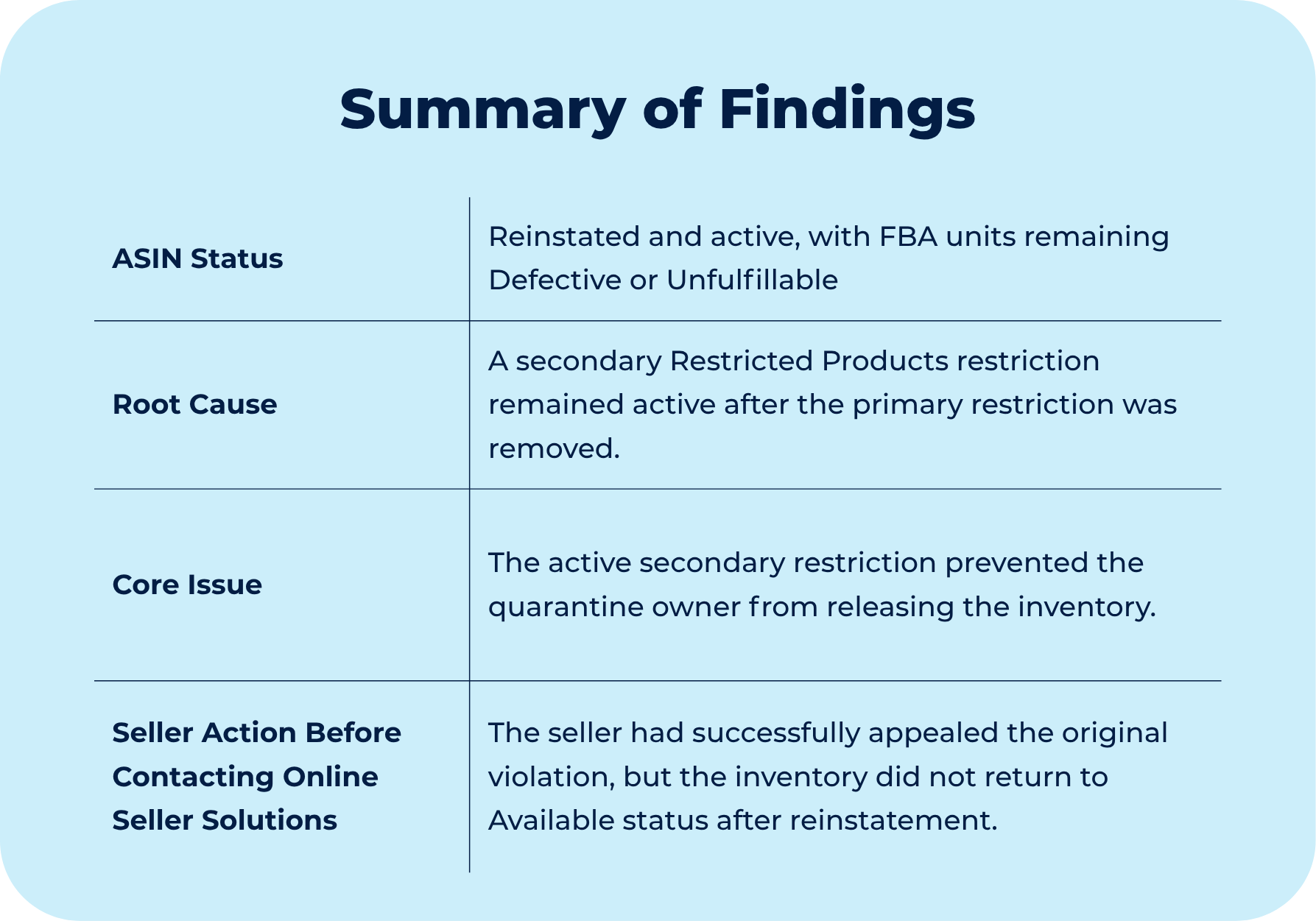
An ASIN was reinstated and cleared from Account Health, yet every unit remained marked as defective.

If you’re new here, welcome.
If you’ve been reading for a while, thank you for being here.
Each week, OSS Lab breaks down one real Amazon case from the field. Not to share tactics, but to decode how Amazon's system actually behaves and what to do when it breaks.
All past cases live in a single searchable archive, built to help you identify recurring patterns across time.

OSS LAB is powered by Online Seller Solutions, the Amazon operational team behind the cases we publish, working directly inside Seller Central to resolve complex operational issues. Contact Online Seller Solutions to learn more about our Amazon services and how we can help resolve the issues affecting your account.
Context
Amazon reinstated the ASIN, but left the inventory blocked
The ASIN had been suspended due to a Restricted Products violation related to disease or medical condition claims.
The seller filed an appeal, and after review, Amazon accepted it. The suspension was lifted, and the violation disappeared from Account Health.
At that point, the seller’s logic was straightforward. The violation was gone from the dashboard, so the case was closed, and the inventory should return to sellable status on its own.
That logic held for the parts of Amazon’s system the seller could see.
It did not hold for the parts that remained hidden, where the original restriction had triggered downstream flags that Account Health never displayed or tracked toward resolution.
Diagnostic
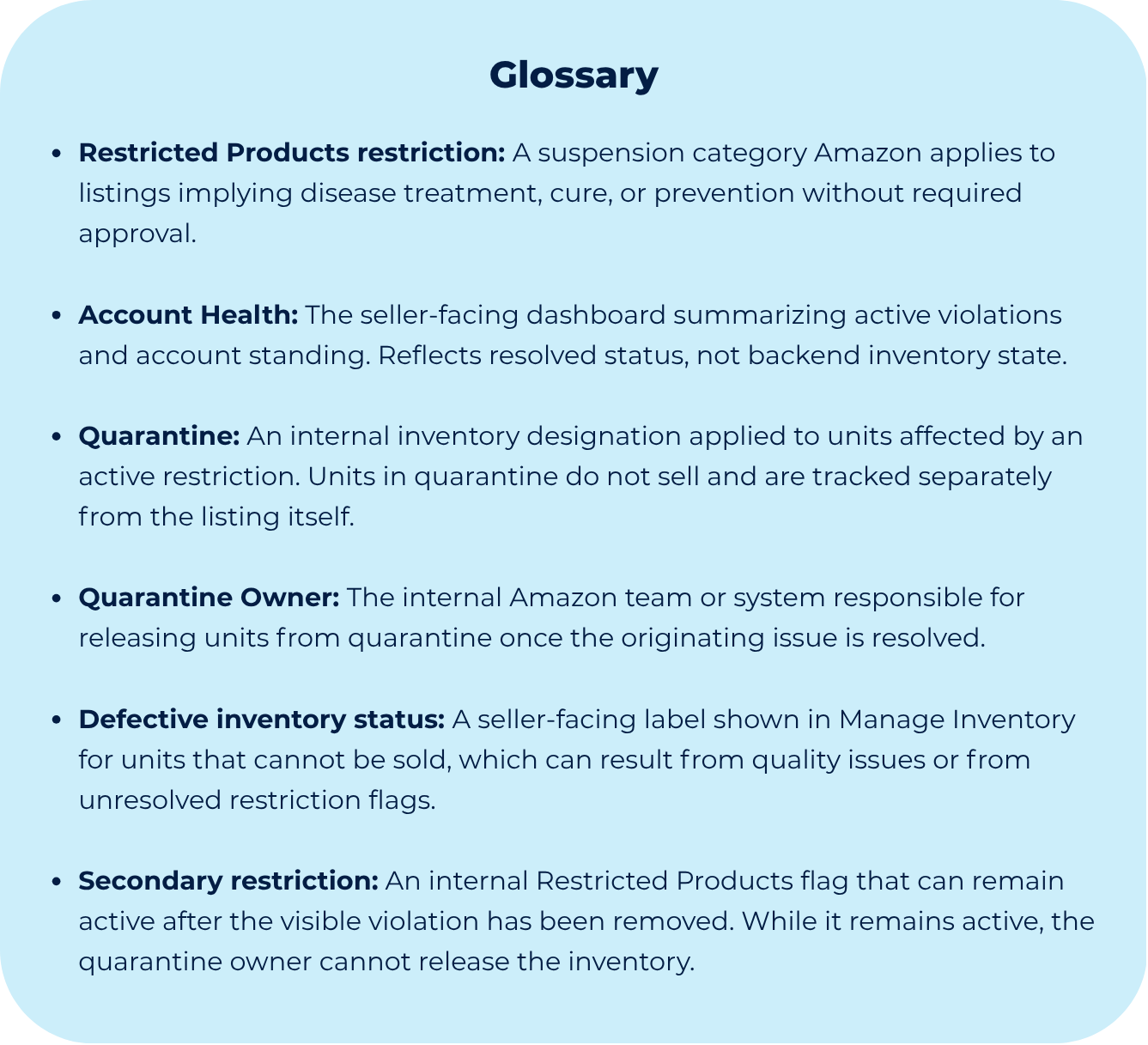
A secondary restriction kept the inventory in quarantine
Account Health and the ASIN listing view are seller-facing surfaces, and for that reason they reflect the outcome of a review, not the full state of every backend system that review touched.
In this case, the appeal resolved the customer-facing restriction, and that resolution correctly propagated to Account Health and to the live listing.
But it did not propagate to the inventory layer, so the units flagged during a Restricted Products suspension get moved into a status Amazon calls “quarantine”, a designation that exists in the inventory management backend, separate from the listing and separate from Account Health.
Under the expected workflow, the quarantine should clear after the originating restriction is removed. In this case, that handoff did not happen.
When Seller Support reviewed the case, Amazon’s backend records still showed an active restriction, despite Account Health showing it as resolved.
That contradiction pointed to a second, undocumented layer, an internal flag tied to Restricted Products that mirrors the primary restriction but does not automatically inherit its resolution.
The appeal cleared the visible restriction, but two backend conditions remained connected: the secondary restriction and the inventory quarantine.
The visible restriction was removed, but the secondary restriction remained active. As a result, the quarantine owner could not release the inventory, and the units remained defective.
If your ASIN has been reinstated but the inventory remains defective or unavailable, contact Online Seller Solutions.
Our Amazon experts can identify which internal restriction is still active and manage the escalation required to release the inventory.
Though Process
Why another appeal would not release the units
Once Account Health cleared, the obvious next step was to wait and assume the inventory would return to sellable status on its own.
My recommendation is not to take that assumption and, first, check whether the units are quarantined and ask Seller Support to identify the quarantine owner. That information determines whether the case is a normal delay or an actual block.
In addition, it is important to hold on for a second and not file another appeal when the original appeal has already been approved, since a new appeal would address the visible violation again, not the secondary restriction keeping the inventory in quarantine.
Seller Support could identify the quarantine owner and confirm that an internal restriction remained active, but frontline associates did not have permission to remove that restriction themselves.
Standard Seller Support and specialist escalations confirmed that a restriction remained, but they could not remove it, meaning that the resolution required an internal ticket to a specific Amazon team which has access to the secondary restriction system.
Moving the case through specialist and internal escalation channels was necessary because frontline support could see the restriction but did not have permission to remove it.
Want to see how the case was actually resolved?
Premium subscribers get access to the full breakdown, including:
The exact order of operations to follow, from initial verification through final escalation
The evidence templates used to request quarantine owner identification from Seller Support
The escalation wording used to reach the internal team
The “What This Teaches You” section, which explains how to evaluate any reinstated ASIN with inventory that remains unavailable
The entire archive of every premium OSS Lab case study published to date, instantly unlocked
Additional Amazon system behaviors, enforcement patterns, and operational intelligence available exclusively to OSS Lab members
