

Case #030 - 🌎 UAE Business Location Blocked This Seller’s US Account
The seller had the right documents, the right company, and the right intent. Amazon's identity system still rejected him, three times, across two countries.
If you’re new here, welcome.
If you’ve been reading for a while, thank you for being here.
Each week, we break down one real Amazon case from the field. Not to share tactics, but to decode how Amazon’s system actually behaves and what to do when it breaks.
All past cases live in a single searchable archive, built to help you identify recurring patterns across time.

Context
UAE business location blocked the US account
The seller operated a business registered in the UAE and used that entity to open a Seller Central account in the United States. At the time of setup, the information matched, the documents were valid, and the account was approved, to the point where they even sent inventory to FBA.
Then the account was suspended.
All of this was related to the fact that the seller had since incorporated a US-based LLC and needed the account to reflect that entity. The old UAE registration number was no longer valid, and the business details had to be updated to match the new US incorporation.
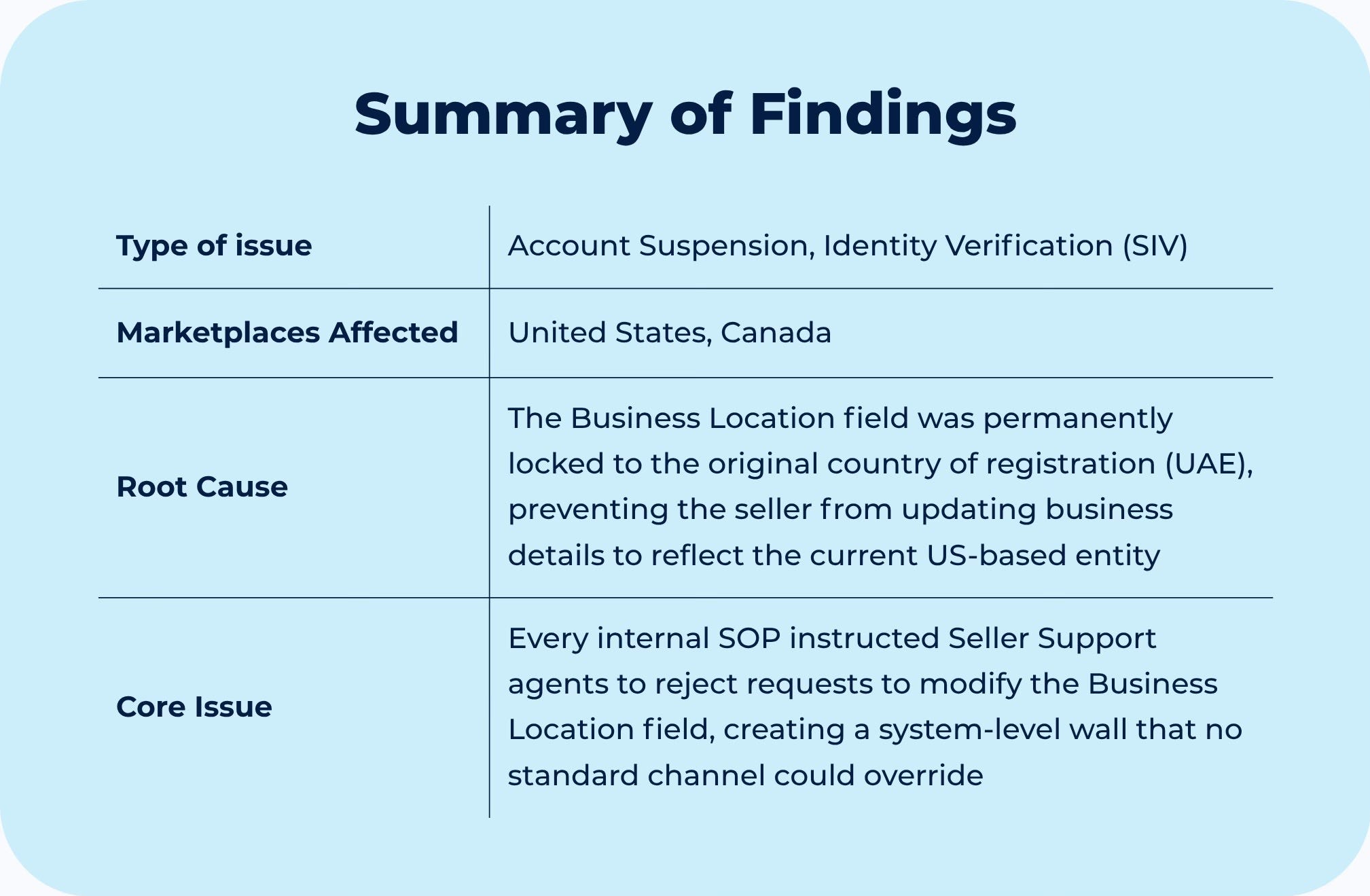
That update required changing the Business Location field.
As we would all expect in this kind of scenario, the seller assumed the issue was limited to the US.
It was not... and the verification failure was originated in the Canada marketplace, where the same identity fields were locked and could not be edited through Amazon.
Here is where the case broke down. If any seller navigates to their Account Info page, opens the “Business Information” section, and clicks on “Business Location” or “Country of Origin,” that field will always appear grayed out. It is non-editable by design.
During account creation, Amazon explicitly warns that this field cannot be changed and instructs sellers to review it carefully before continuing.
So no, this was not a bug, the fields are read-only, so any escalation paths were slow, and the identity verification team operated on its own timeline, disconnected from standard Seller Support.
The seller assumed this was a documentation issue, something that could be resolved by uploading the correct identity documents. In reality, no amount of correct documentation could fix the account, because the system would not allow the underlying field to be updated. Every document submission was evaluated against a country that no longer matched the seller’s actual business entity, and every submission failed as a result.
In addition to the account being suspended, inventory remained in Amazon’s fulfillment centers.
So Monthly Inventory Storage Fees continued to accrue on every unit, and the seller had no ability to sell through the inventory to offset those costs. The suspension also restricted access to the tools needed to create removal orders, meaning the seller could not retrieve the inventory either.
Every week the case remained unresolved, the financial exposure grew, not because of a policy violation, but because of the compounding effect of time and restricted access turning one marketplace error into an ongoing cost in another.
Diagnostic
The business location field could not be edited
The identity verification system on Amazon operates through what is internally referred to as the SIV (Seller Identity Verification). This lies beneath Seller Central’s visible UI and determines whether a seller’s documentation meets the platform’s compliance thresholds across all marketplaces in a region.
In this case, the seller’s North American account was unified, meaning the US, Canada, Mexico, and Brazil marketplaces shared a single identity verification state.
When the system detected a mismatch between the submitted business documents and the registered Business Location, the entire regional account was affected. The suspension notification appeared only in the US, leading the seller to believe the problem was local to that marketplace.
The root of the issue was the Business Location field itself.
From the seller’s perspective, the UAE entity was no longer the operating company, and the US-based LLC replaced the previous one, and the account needed to reflect that reality. But the system had no path for this kind of update, so the verification process kept evaluating the seller’s US documents against a UAE registration, and every submission failed because the country did not match.
On top of the locked Business Location, the Company Registration Number and Primary Contact fields in the CA marketplace were also frozen at the UI level.
This is a known behavior when Amazon’s backend has initiated a verification cycle, the system locks fields to prevent mid-review changes, but it does not communicate this to the seller. The result was a state in which the seller was asked to update information the system would not allow them to update.
We had seen this exact pattern once before, roughly two years prior. In that case, we managed to get the Business Location field unlocked through an escalation to Amazon’s Executive Relations Team. We did not know exactly how the associate on that case accomplished it on the backend, but we knew it was possible. That precedent shaped our entire approach.
If your account is suspended due to an identity verification issue and standard support is not resolving it, schedule a diagnostic with our team. We will investigate the root cause, determine whether a path forward exists, and give you a clear picture before quoting any remediation work.
Though Process
Why standard support could not fix the account
When the seller first mentioned the possibility of opening a new account under his US-registered LLC, we did not pursue that path, but opening a second account while the first is under suspension creates a direct association risk, since Amazon’s systems are designed to detect related accounts, and if the new account is linked to the same individual or business entity, both accounts may be permanently terminated.
The instinct to start fresh is understandable, but doing so in this context would have made things worse.
But the real decision point in this case was recognizing that the standard support structure could not help, because we contacted every available channel:
Account Health
Seller Support
Specialist Support
and requested escalations to the SIV team.
Every team followed their SOPs. Every SOP said the Business Location field could not be changed.
So every agent was correct to refuse, because that is exactly what their internal documentation instructed them to do.
The question was whether a mechanism existed above the SOP layer that could override the restriction. We believed it did, because we had seen it happen once before.
Roughly two years prior, in a different case with the same constraint, we escalated to the Executive Relations Team, and an associate on that team managed to reset the entire Business Information page, that is what gave us the confidence to pursue the same path here, even after every other channel had closed its door.
The specific escalation method we used, including where to send it and how to structure the request, is detailed in the Solution section below.
After the US verification succeeded, we recommended the seller not attempt to resubmit identity verification in Canada. The US and CA marketplaces share a verification layer, and a new rejection in CA could have destabilized the recently approved US verification. The risk of losing what had just been recovered outweighed the benefit of gaining access to a secondary marketplace the seller did not plan to use.
Does this case sound interesting?
Check out what you will find in the next sections:
The full step-by-step remediation sequence, including the exact escalation structure used to unlock a permanently grayed-out Business Location field
A self-attestation letter example
The self-attestation letter framework for multi-entity ownership structures
How the Executive Relations Team reset the Business Information page when every SOP said it could not be done
The “What This Teaches You” section, where we extract the larger Amazon pattern behind the case
The entire archive of every premium OSS Lab case study we’ve published, instantly unlocked
Additional Amazon system behaviors, enforcement patterns, and operational intelligence we reserve exclusively for OSS Lab members
