


If you’re new here, welcome.
If you’ve been reading for a while, thank you for being here.
Each week, we break down one real Amazon case from the field. Not to share tactics, but to decode how Amazon’s system actually behaves and what to do when it breaks.
All past cases live in a single searchable archive, built to help you identify recurring patterns across time.
Context
When the comparison itself is the defect
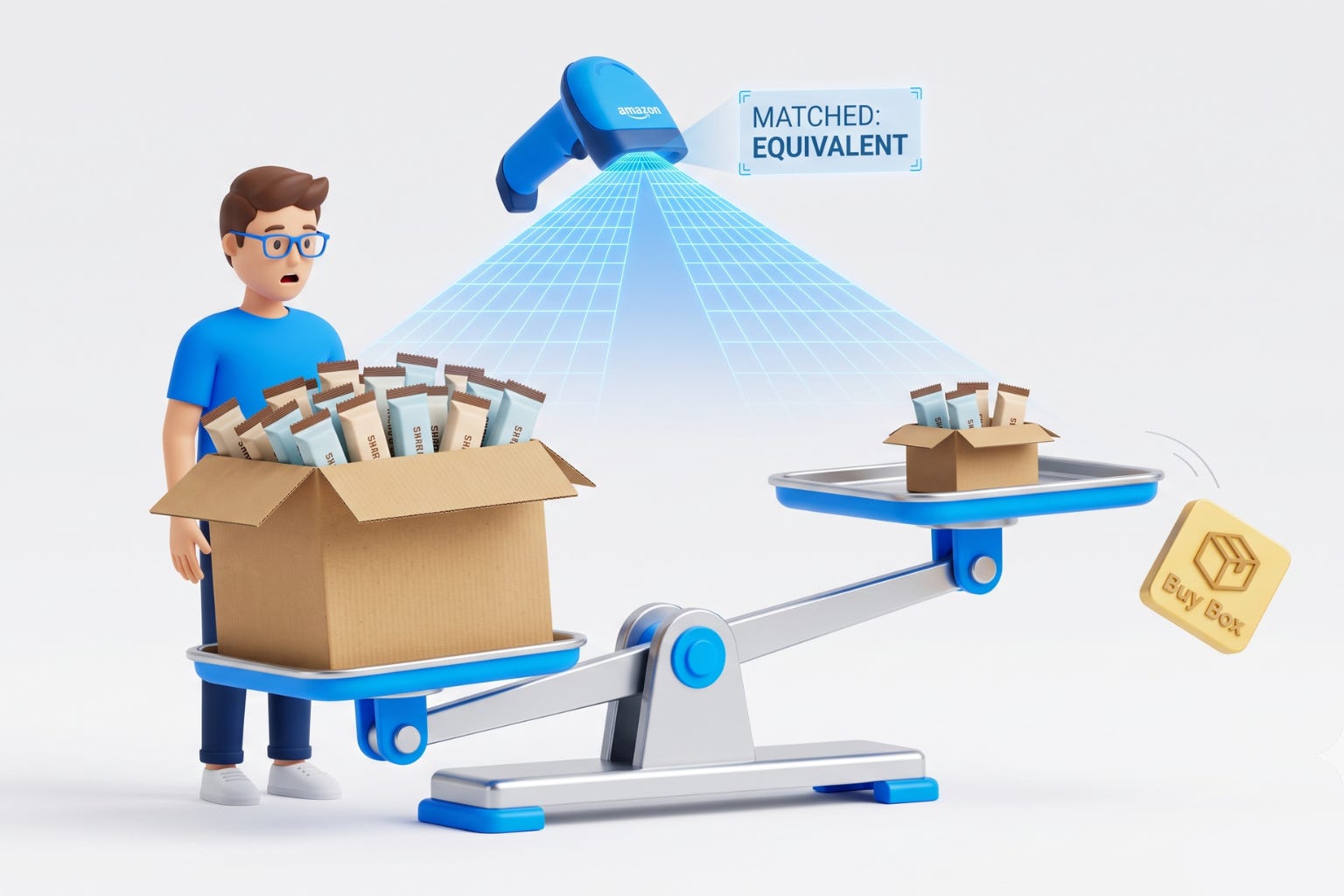
A seller came to us with a Buy Box eligibility issue on one ASIN, a 15-count item box sold on Amazon.
In general, when this type of issue happens, we all know the drill: adjust the price, wait for the system to recheck, move on.
What made this case different was where the comparison price was coming from.
Because the seller also sold a smaller version of the same product, a 4-count box, through their own website and through another external retailer.
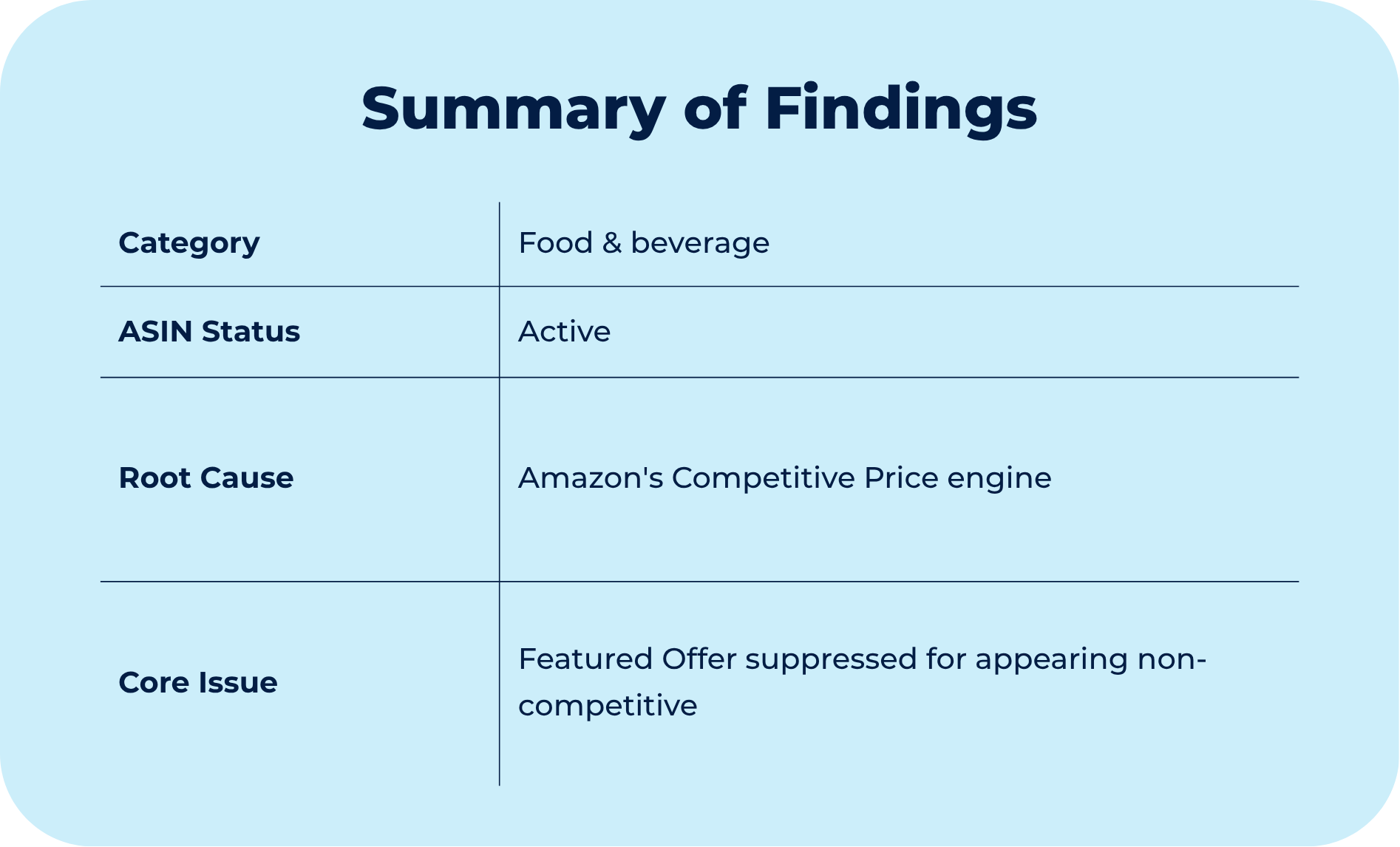
But for some reason we will never know, Amazon’s Competitive Price engine pulled the per-unit price from that smaller pack, then applied it as if it belonged to the 15-count version.
What we understand from this context is that when products share a name, a formula, and a brand, Amazon uses that information to correlate them.
But in terms of the system, what would be easy to assume that was a repricing problem, was actually a catalog matching problem where the system was treating two different SKUs as economically equivalent when they were not.
Diagnostic
The comparison outranks the actual price
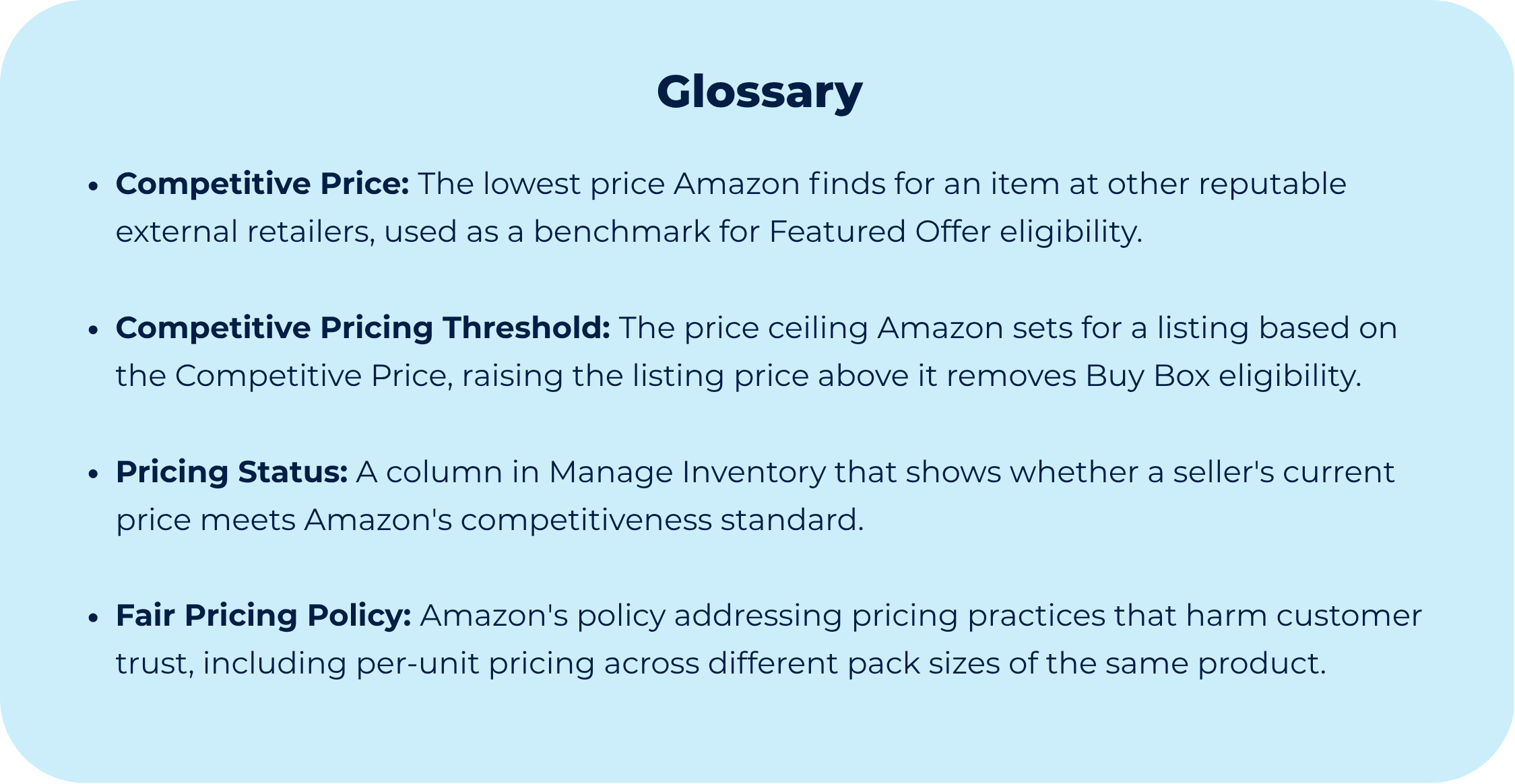
Amazon’s Featured Offer eligibility depends on a Competitive Price signal from external retailers, and the Manage Inventory page reflects this with a Pricing Status column and a Match button.
That interface in the Manage Inventory page is the only thing that tells the seller whether the current price is considered competitive, but it does not show which external listing generated the comparison or whether that listing represents the same product.
This makes the backend of your listing the second-in-charge of what represents your listing, while the reference that Amazon uses to compare becomes the first.
And that makes more sense when you learn that Amazon’s system identifies external prices for what it determines to be a matching product, then applies that price at face value against the ASIN, without normalizing for unit count first.
Which is exactly what happened in this case.
The system treated the smaller version’s price as the relevant benchmark for the larger version, which made the Amazon listing appear overpriced by a wide margin, even though the price itself was accurate.
But since the ASIN was configured correctly, and the price was correct for the product it represented, the failure sat in the layer that decides which external listing counts as equivalent, a layer the seller never has direct visibility into.
If this pattern looks familiar in your account, we can determine whether the issue is pricing, catalog matching, or something else entirely, and what a path to resolution looks like.
Contact Online Seller Solutions.
Though Process
Why we did not just match the price
The fastest option on the table was to lower the Amazon price to match what the system flagged as competitive, and in most cases that would have closed the gap within a day.
But we set that option aside, since the reference price belonged to a different set of the product, so matching it would have meant pricing the larger version as if it were the smaller one, permanently.
Luckily enough, Amazon’s Fair Pricing Policy is written for a specific scenario, where the same product is sold at different unit counts, priced inconsistently on a per-unit basis.
And this case sat outside that scenario, the two configurations were distinct products, not the same item scaled differently, which meant the policy itself did not apply the way the system had applied it, and that was a point we could use on our favor.
That distinction became the basis for the solution process, because rather than adjusting the price, we built a record showing the Amazon price already reflected fair market conditions, supported by the seller’s own pricing elsewhere and the ASIN’s sales history over time. A system enforcing a rule against the wrong comparison responds to proof, not to a lower number.
Does this case sound interesting?
Check out what you will find in the next sections:
The complete step-by-step appeal process used to restore Featured Offer eligibility without lowering the price.
The exact evidence package submitted to Amazon.
The appeal template used to request escalation to Amazon's Internal Pricing Team.
The “What This Teaches You” section, explaining the broader Amazon system pattern behind Competitive Pricing Threshold suppressions.
The entire archive of every premium OSS Lab case study we’ve published, instantly unlocked.
Additional Amazon system behaviors, enforcement patterns, and operational intelligence we reserve exclusively for OSS Lab members.
