

Case #026 - 🚫 Ungating failed because of two words on the invoice
A seller submitted the correct documents to resell a brand in Canada, even though the brand confirmed everything, Amazon still said no, twice.

If you’re new here, welcome.
If you’ve been reading for a while, thank you for being here.
Each week, we break down one real Amazon case from the field. Not to share tactics, but to decode how Amazon’s system actually behaves and what to do when it breaks.
All past cases live in a single searchable archive, built to help you identify recurring patterns across time.
Context
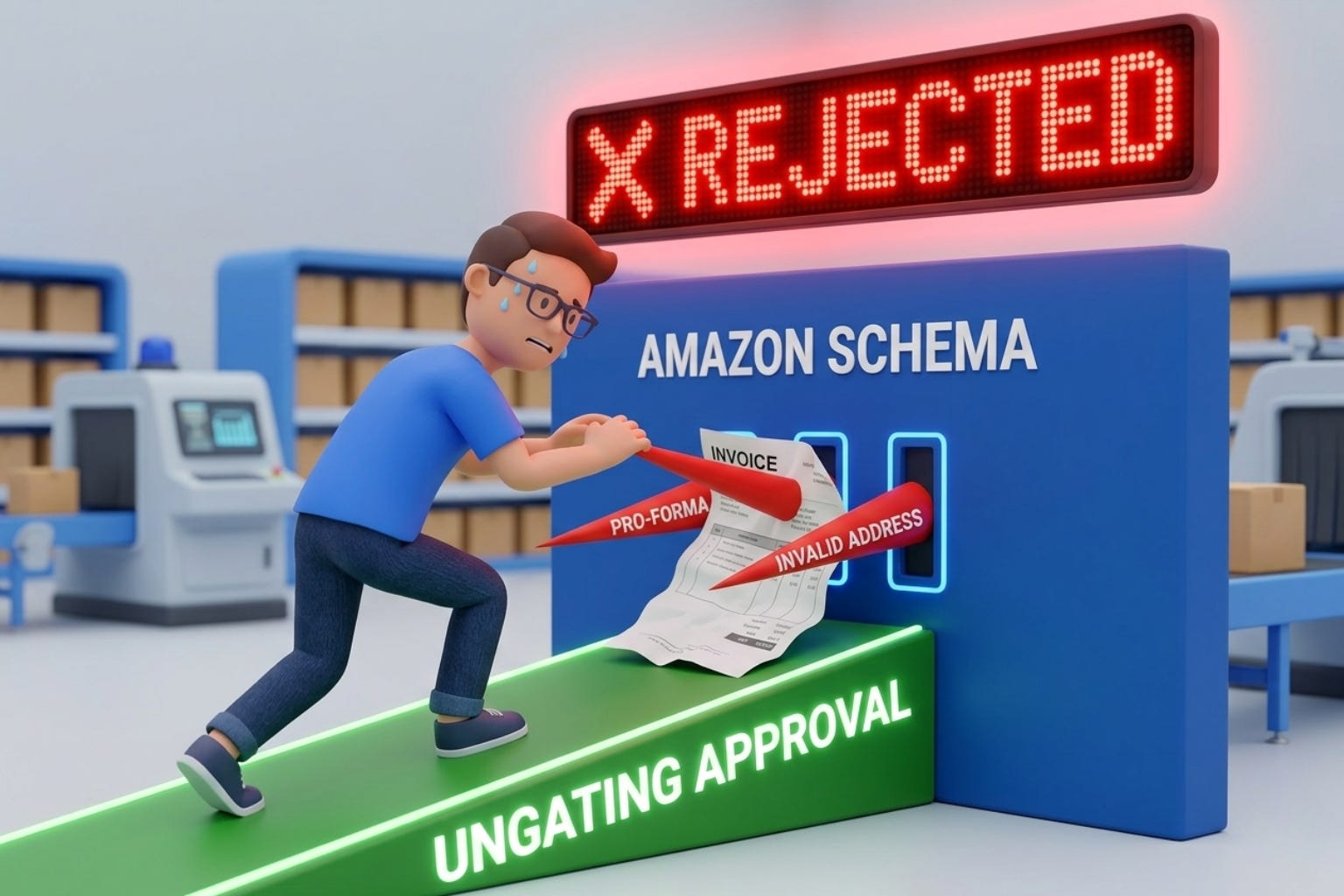
The seller had authorization, inventory, and invoices. Amazon still rejected the application.
The seller held an active supply relationship with a legitimate pet food brand, had inventory, a letter of affiliation, and direct contact with the brand’s team. The logic was straightforward: provide the documents, request approval, and get ungated in the Canadian marketplace.
That logic was not wrong in principle.
It failed because Amazon’s ungating review process does not evaluate the commercial reality of the relationship.
It evaluates whether the documents submitted match a narrow, internally defined pattern. Each field on an invoice, each name on a letterhead, each payment term notation is read as a data signal, not as context.
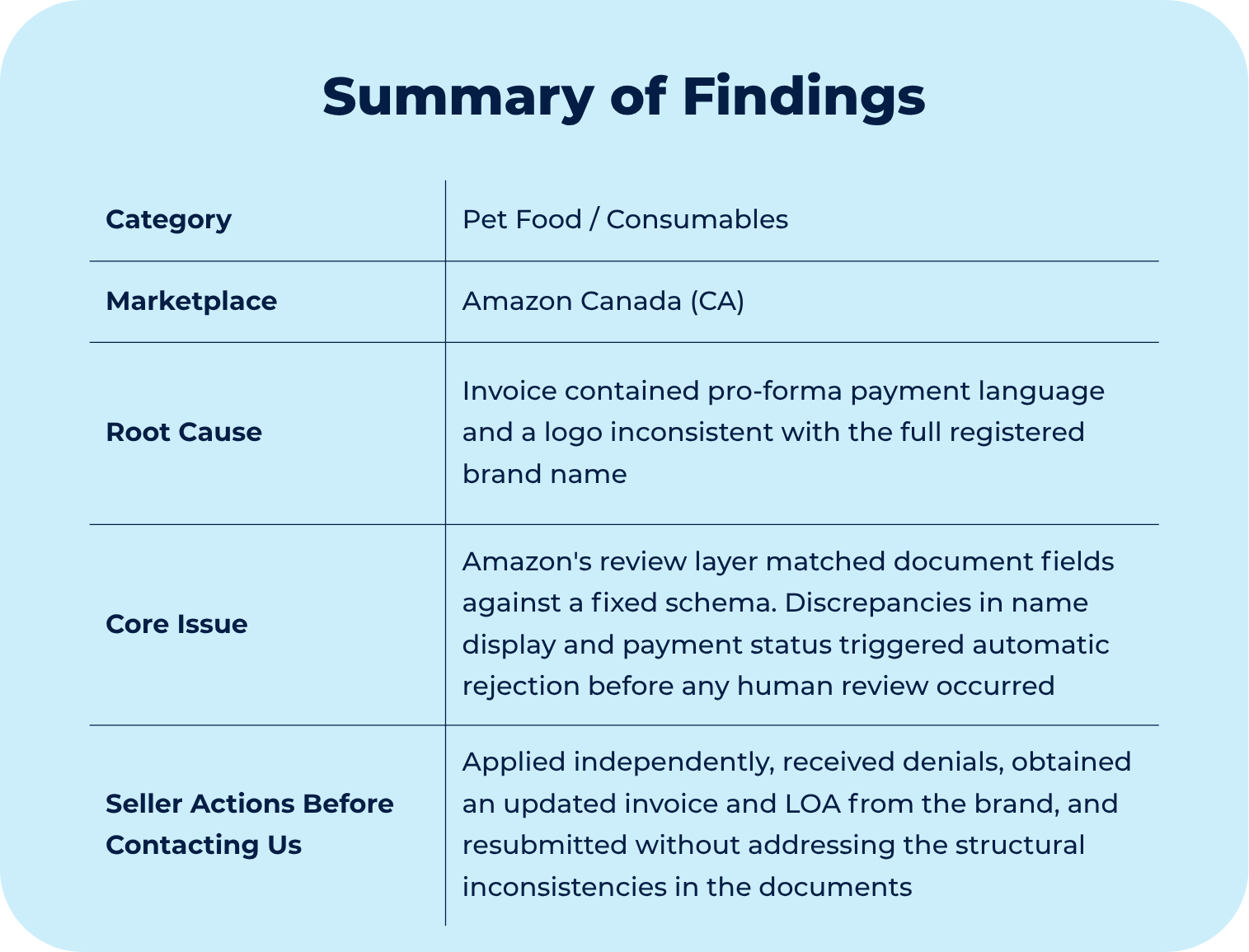
The seller’s invoice carried the brand’s logo with a shortened version of the brand name, the full legal company name appeared only in the footer, and the payment terms included language that Amazon’s system associates with pre-transaction documents rather than completed purchases. The letter of affiliation existed, but did not address any of these discrepancies in writing.
From the seller’s side, these were minor formatting issues. From the system’s side, each one was a reason to reject without further review.
Diagnostic
The exact signals Amazon flagged on the invoice
Amazon’s ungating process for branded categories does not begin with a human reading the documents.
It begins with a structured validation pass that checks for specific signals: the supplier name must be consistent across all document fields, the payment terms must reflect a completed transaction, and the issuing entity must match the brand identity as registered in Amazon’s catalog.
When any of these signals conflict, the application enters a rejection state before escalation pathways become available.
In this case, two signals failed simultaneously.
The invoice logo displayed an abbreviated version of the brand name, while the footer displayed the full legal entity name, and Amazon does not resolve that ambiguity in the seller’s favor.
The second failure was the pro-forma notation in the payment terms field. Pro-forma invoices document a proposed transaction, not a completed one.
Note: Amazon’s policy explicitly excludes them, and the system treats that language as disqualifying regardless of what other fields on the document say.
These are not judgment calls made by a reviewer. They are schema-level checks, and that distinction matters because no amount of context, explanation, or additional documentation resolves a schema failure unless the document itself is corrected first.
Only after the documents were corrected and the letter of affiliation was updated to address the name discrepancy in writing did the application enter a state where escalation could produce a result.
If you are in a similar situation and are not sure whether your documents are structurally ready for an ungating submission, or if you are dealing with an issue that feels unsolvable, we are here to find the right solution for you.
Contact Online Seller Solutions here.
Thought Process
Why we refused to escalate after the second denial
The first instinct in a case with multiple denials is often to escalate immediately.
That instinct is understandable, but it applies pressure to a system that has not yet received valid inputs.
Escalation routes a case to a human reviewer, who still evaluates the same documents, so the result would be the same.
If those documents contain a pro-forma notation or a name inconsistency, the escalation produces the same result as the standard submission, with the added cost of having used the escalation channel before the underlying issue was resolved.
The decision here was to hold the escalation until the documents were corrected. That meant going back to the brand twice: once for a corrected invoice and once for an updated LOA that addressed the logo and name relationship in writing. Only after both documents were in a form that could pass schema validation did we initiate the escalation sequence.
This sequencing matters because escalation is not a retry. It is access to a different review layer, and that layer has limited tolerance for repeat submissions with the same structural problems. Using it correctly means arriving with documents that have already resolved every known failure point.
Below The Paywall
You get access to:
The exact LOA language structure used to address dual supplier naming in ungating submissions.
A breakdown of Amazon’s invoice rejection triggers across category and brand gating processes.
The Solution section is in an easy-to-follow step-by-step format you can use if this happens to you.
The “What This Teaches You” section, where we extract the larger Amazon pattern behind the case.
The entire archive of every premium OSS Lab case study we’ve published, instantly unlocked.
Additional Amazon system behaviors, enforcement patterns, and operational intelligence we reserve exclusively for OSS Lab members.
