

Case #025 - 👻 Ghost data in Amazon's catalog: what it is, and why it stalls your listing
A UPC was corrected. The ASIN reflected the new identifier. Yet the system still rejected every attempt to relist the SKU.

If you’re new here, welcome.
If you’ve been reading for a while, thank you for being here.
Each week, we break down one real Amazon case from the field. Not to share tactics, but to decode how Amazon’s system actually behaves and what to do when it breaks.
All past cases live in a single searchable archive, built to help you identify recurring patterns across time.

Context
When a UPC correction leaves invisible residue in the catalog
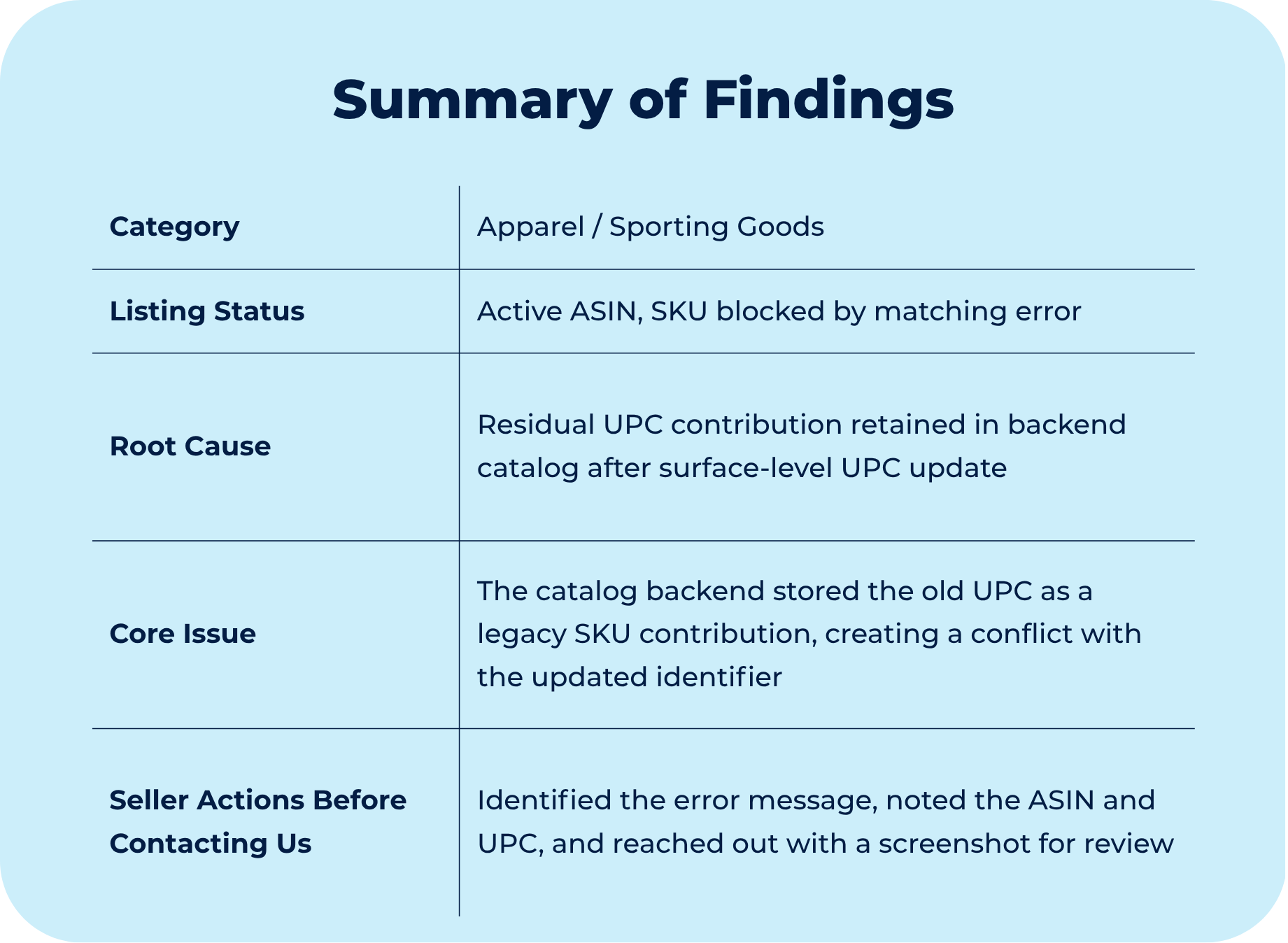
A seller contacted us after receiving a persistent matching error on their product ASIN. The SKU in question had been tied to the listing with a specific UPC at the time of original catalog creation, and at some point after that, the UPC associated with the ASIN was updated to a new identifier, with the ASIN itself reflecting that change on the surface.
The seller’s assumption was straightforward: the UPC had been changed correctly to a GS1 barcode, the catalog record reflected the new value, and the listing should have behaved accordingly. From the Seller Central interface, there was no visible indicator that anything remained out of alignment. The ASIN page showed the updated UPC, the product title and variation structure appeared intact, and there were no suppression flags visible in the standard inventory view.
What the seller did not have visibility into was the backend of the catalog, where contributions are stored independently from what appears on the product detail page or inside the “Edit Listing” in Seller Central.
The original UPC contribution remained attached to the SKU even after the visible catalog record had been updated. As a result, the system held both the current identifier and a residual contribution associated with the original listing creation.
When the system processed a new attempt to match or relist the SKU, it encountered conflicting UPC contributions associated with the same SKU and returned a matching error rather than resolving the discrepancy on its own.
Diagnostic
How a retained UPC contribution created a matching error
Amazon’s catalog operates in layers. What a seller sees in Seller Central, the product detail page, or the Manage Inventory grid represents the rendered output of a catalog that stores contributions separately from what gets displayed. When a UPC is updated on an ASIN, the visible record changes, but the contribution tied to the original SKU does not automatically overwrite the old one.
In this case, the SKU was originally contributed with UPC A. The ASIN was later updated to reflect UPC B, while the backend continued to hold UPC A as an active contribution associated with that same SKU identifier.
When the system evaluated a new listing attempt or matching request, it continued recognizing the retained UPC contribution associated with the SKU, resulting in a matching error.
What makes this case even more interesting is that the SKU was not active in the seller’s inventory at the time of the error. That removed the standard deletion path from consideration. Normal deletion requires an active offer, and without it, the standard inventory management tools do not surface the SKU as a removable object, leaving the residual contribution embedded in the catalog without an obvious interface-level mechanism to clear it.
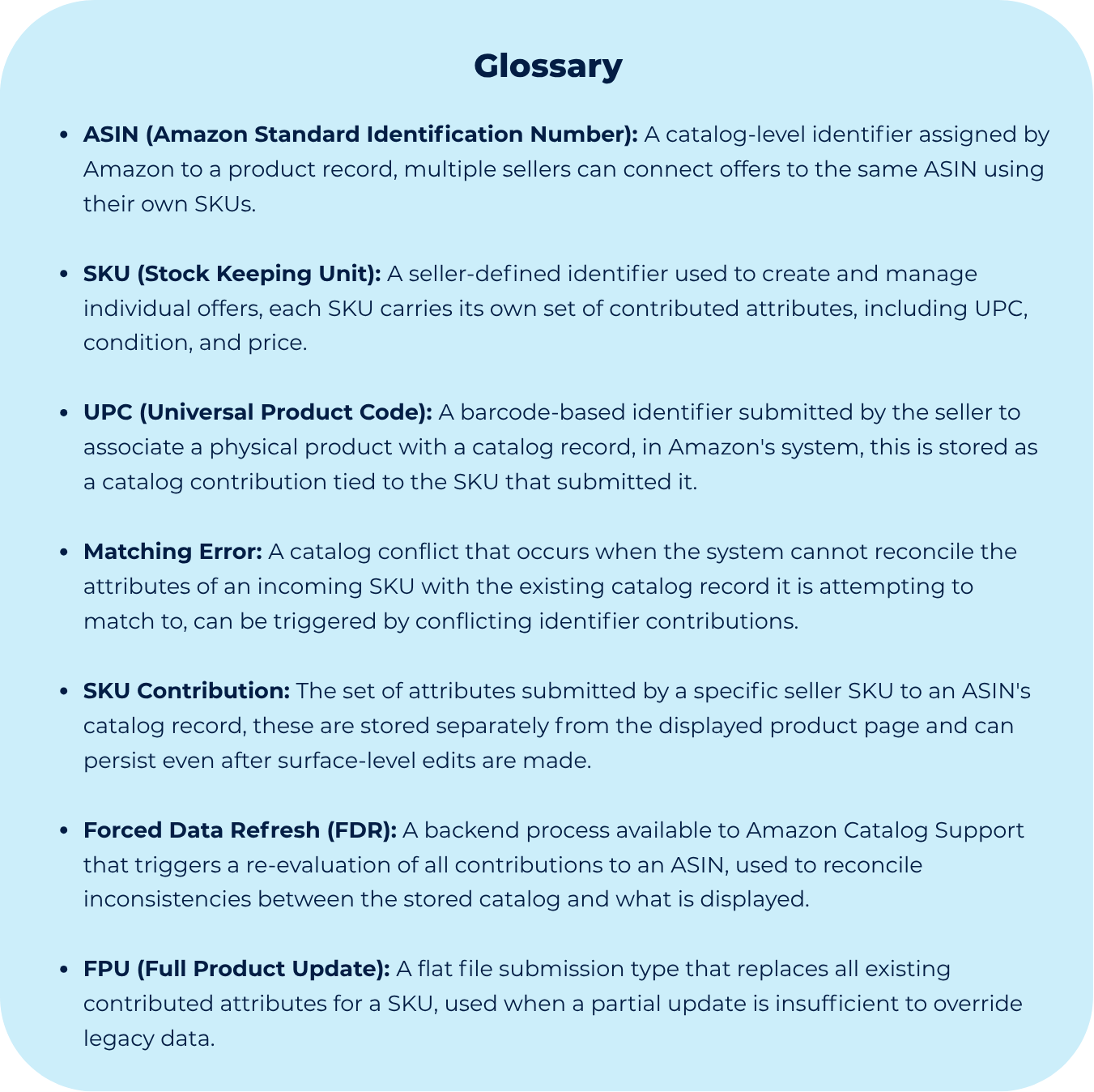
The distinction that matters here is between the ASIN record and the SKU contribution. The ASIN is a catalog node. The SKU is a seller-specific offer record that carries its own set of contributed attributes. Updating the ASIN does not automatically remove or replace every contribution historically associated with the SKU.
If you are dealing with a catalog error that has not responded to standard fixes, we offer a diagnostic to identify exactly where the system is holding and what it will take to clear it.
Contact Online Seller Solutions here.
Thought Process
Why standard deletion and flat file updates were ruled out before escalating
The first instinct in a case like this is typically to delete the SKU and relist it. This path works when the offer is active because the deletion removes the offer record and, in most scenarios, clears the associated contributions.
But in this case, the SKU was not active in the seller’s inventory, which meant the standard deletion flow did not apply, and there was no offer to delete through the Manage Inventory interface.
Submitting a new flat file with updated UPC data was considered as an alternative, but a partial update would not have been sufficient. Partial updates modify specific fields without replacing the full contribution set, and in a conflict state where multiple UPC values are already associated with the same SKU, a partial update risks adding another contribution rather than resolving the existing conflict.
A Full Product Update addresses more of the contribution layer, but it still assumes that the underlying contribution records are in a state that can be overwritten. In this case, the issue was not the current UPC value itself, but the residual contribution data that remained associated with the SKU after the correction had already been made.
The evaluation led to a path that required addressing the residual contribution data before any relisting attempt was made. That is why Catalog Support involvement became necessary. The issue was not the visible listing itself, but the contribution history attached to the SKU.
The sequence mattered as much as the individual actions. Relisting before the residual data had been cleared would have reproduced the conflict, while attempting additional updates before addressing the underlying contribution records would have extended the resolution timeline.
The order of operations was determined by the structure of the constraint itself, not by trial and error.
Below The Paywall
You get access to:
The exact three-step process used to remove the residual UPC contribution and clear the matching error.
The specific Catalog Support wording used during the investigation.
The escalation and decision logic that determined why relisting alone would not solve the problem.
The “What This Teaches You” section, where we extract the larger Amazon pattern behind the case.
The entire archive of every premium OSS Lab case study we’ve published, instantly unlocked.
Additional Amazon system behaviors, enforcement patterns, and operational intelligence we reserve exclusively for OSS Lab members.
