

Case #023 - 🥴 Amazon said the listing was active, but it wasn't buyable.
A listing showed as active in Seller Central, but customers could not buy it, while the variation theme could not be edited because the parent was owned by Vendor Central.

If you’re new here, welcome.
If you’ve been reading for a while, thank you for being here.
Each week, we break down one real Amazon case from the field. Not to share tactics, but to decode how Amazon’s system actually behaves and what to do when it breaks.
All past cases live in a single searchable archive, built to help you identify recurring patterns across time.
Context
When the catalog belongs to someone else
A 3P seller, authorized by a major supplement brand through Brand Registry permissions, was tasked with reorganizing four variation families in Seller Central.
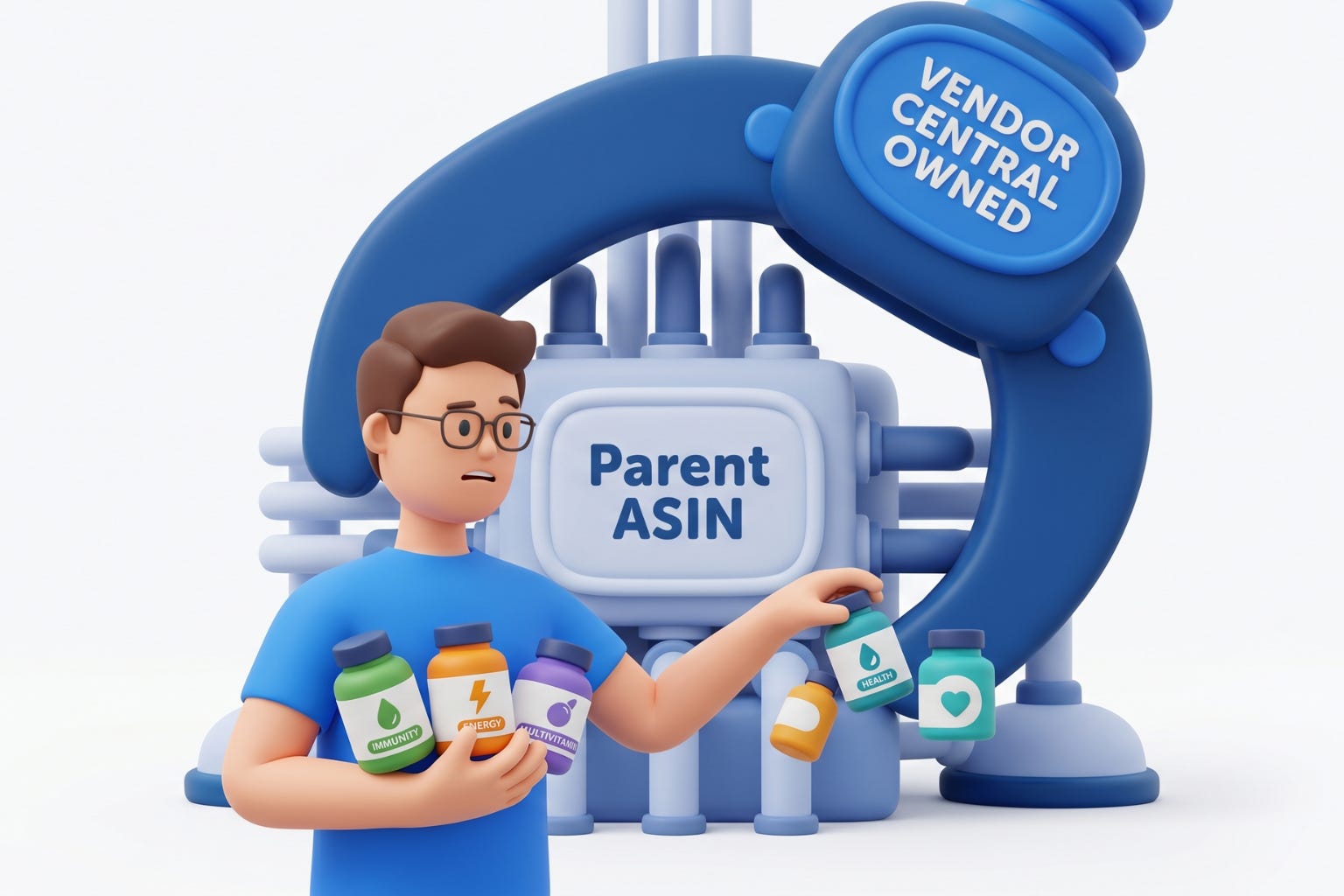
The thing was that the brand owned the parent ASINs through Vendor Central, and the child ASINs had been removed from the brand’s Vendor Central catalog due to chargeback disputes, so the seller was given permission to rebuild the variation structure from their 3P account.
The initial logic was sound: identify the correct variation theme, dissolve the existing families, and recreate them using flat files with the updated theme. The seller had done this before, the brand had authorized the work, and the ASINs were active products with existing catalog records.
When they started working on it, the problems started.
The first issue appeared immediately: the variation theme on the existing parent could not be edited through any standard Seller Central workflow.
The second issue was structural: the parent ASINs were not in the seller’s inventory because they were created and owned by the brand’s Vendor Central account. Since a 3P seller cannot dissolve a variation family built on a parent they do not control, a specific Amazon team must intervene and orphan the children first.
While that process was underway, a child ASIN connected to the first family became unbuyable, without any suppression, policy flag, or account health signal to explain it.
The dashboard said it was active, while the detail page said otherwise.
Diagnostic
The system that shows is not the system that decides
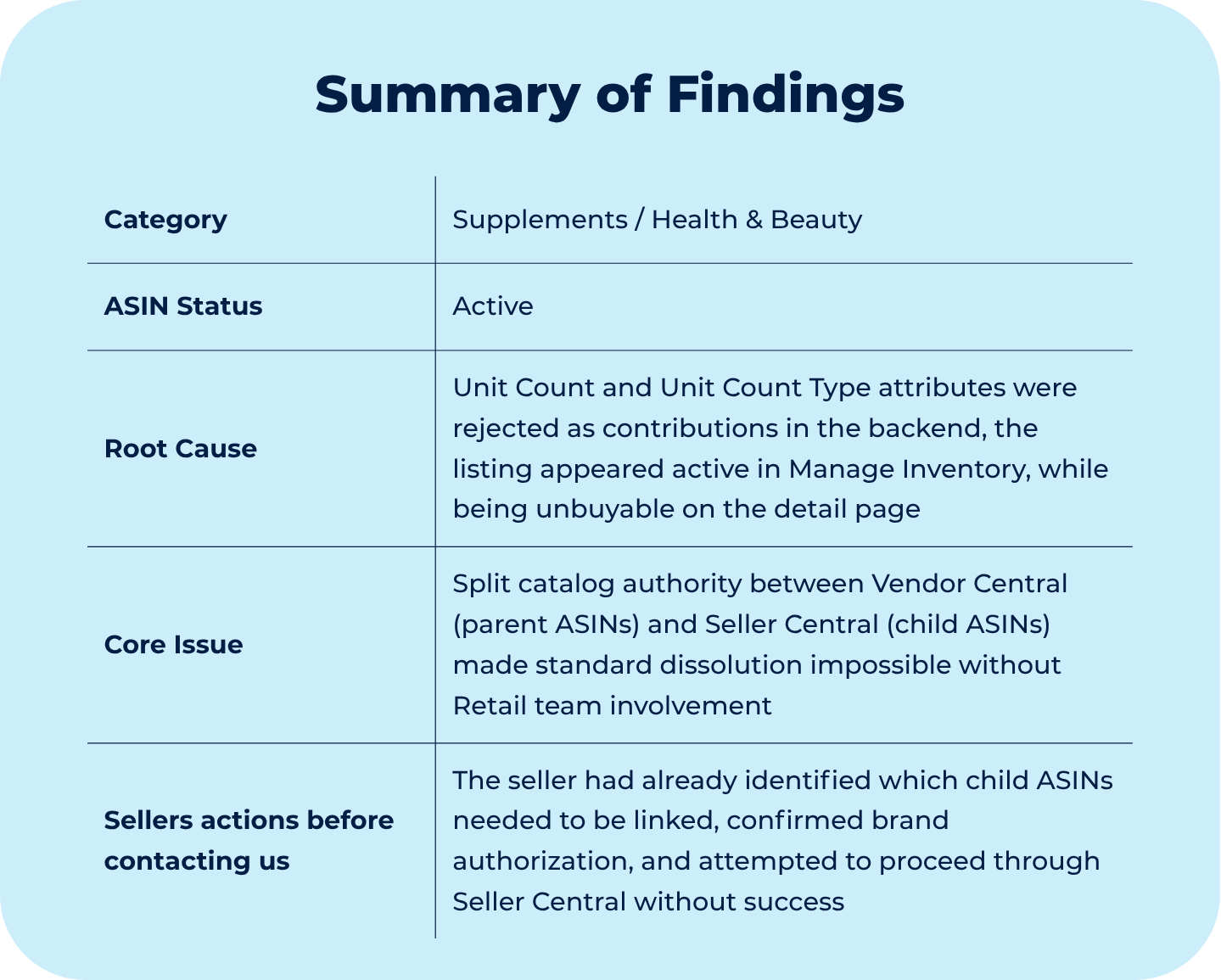
Variation themes can be updated via flat-file submission or through Seller Support under normal circumstances, but in this case, the existing parent could not be modified on Seller Central, and the dissolution required intervention from a specific internal team.
Because a Parent ASIN created through Vendor Central has an ownership record separate from any 3P Seller Central account.
This means that a seller with Brand Registry authorization can contribute to child ASIN attributes, but they cannot dissolve or recreate a variation family built on a parent they do not own in their own account, and the severance of those child-parent relationships has to originate from the account that created the parent.
Separate from the variation structure problem, one of the child ASINs stopped being purchasable during the project, with no suppression notice, no policy flag, and no account health alert to indicate why, the listing showed as active in Manage Inventory and the detail page loaded normally, but the Buy Box and the purchase option were gone, even if the price or in the category had not changed, and no external factors like a different pricing on another website explained the disappearance.
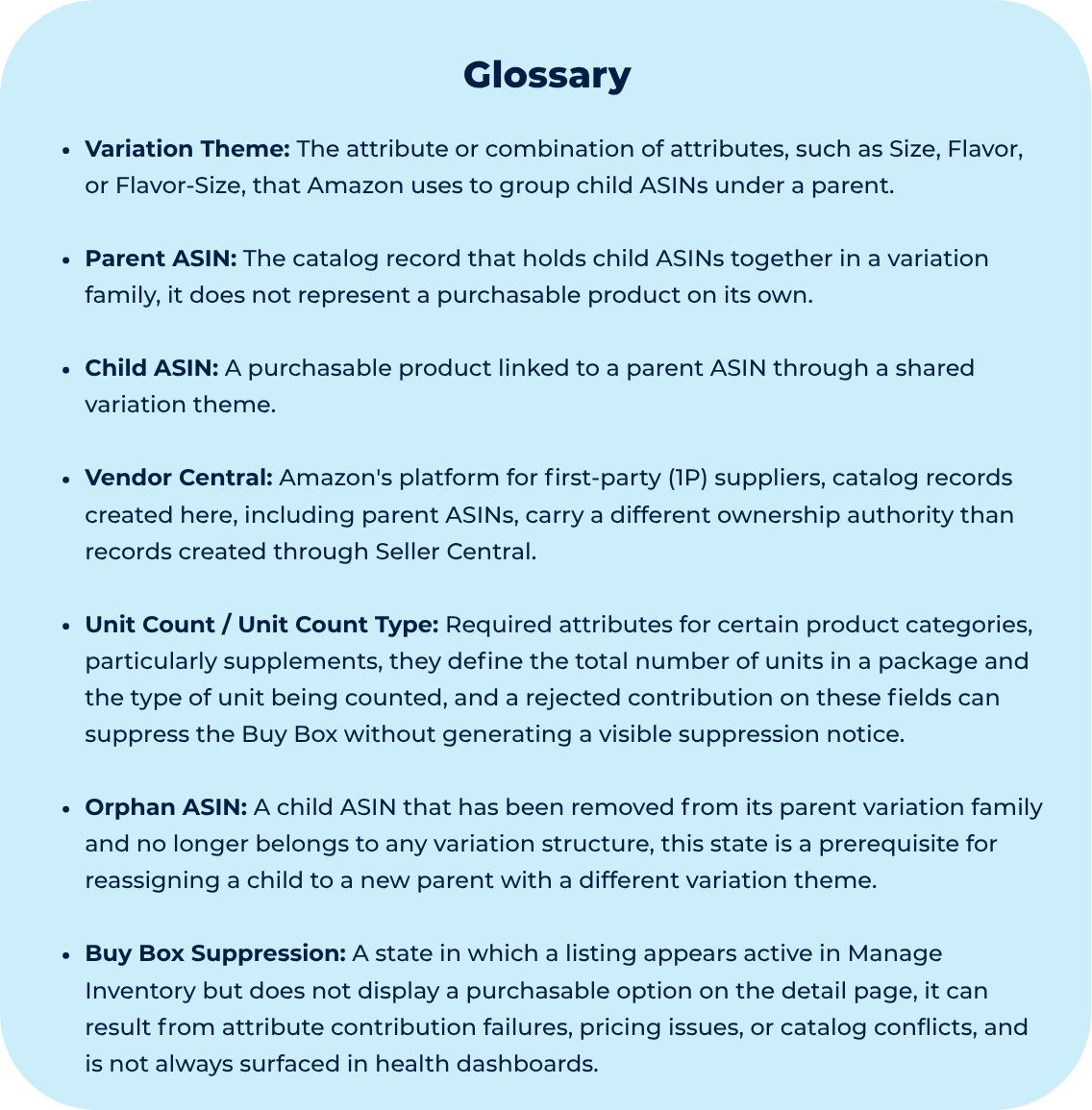
That is why it is worth knowing that losing the Buy Box is not always a pricing problem, there are cases where the cause sits entirely at the attribute contribution level, and what Seller Central shows as “Active” only means the listing exists in the system, it does not mean every required attribute has been accepted, and a listing can be active and unbuyable at the same time.
If you are dealing with a variation structure that cannot be edited through standard Seller Central tools, or a listing that shows as active but will not display a Buy Box, we work through these cases regularly, and you can reach us
We do the heavy lifting while you focus on your business
Thought Process
What the system allows, not what seems logical
The first instinct was to update the variation theme through a support case or flat file on the existing parent, the brand had authorized the changes, the seller had catalog access, and the accounts were properly linked, so updating the theme seemed like a straightforward request, those paths exist and work under normal circumstances, but in this case every submission from the Seller Central side failed to move the structure, and the dissolution could not be executed without the Amazon internal team intervening at the Vendor Central level.
The same constraint applied to the authority over the parent record, submitting a flat file that references a parent ASIN is not the same as having the system accept that submission, and when the parent originated from Vendor Central, no action from the 3P account was enough to restructure it, the change had to come from the team that owned that record.
When the child ASIN became unbuyable with no visible suppression, the case itself provided the next direction, and it guided us to check the all visible content on Seller Central to know if something wasn’t matching with the product, after checking everything returned clean, which meant the problem was not something the UI was reporting on, it was happening at a layer below what dashboards surface, and that layer is only reachable by reviewing which required attributes had been submitted and whether the backend had accepted or rejected each one.
This is where the Unit Count and Unit Count Type attributes were identified as the failure point, those are required contributions for supplement listings, and when the values were submitted in a format the backend rejected, the system blocked the contribution without surfacing any alert, the account-level record stayed intact, and the Buy Box disappeared because the catalog contribution had failed at a layer the dashboards were never designed to report on.
