


If you’re new here, welcome.
If you’ve been reading for a while, thank you for being here.
Each week, we break down one real Amazon case from the field. Not to share tactics, but to decode how Amazon’s system actually behaves and what to do when it breaks.
All past cases live in a single searchable archive, built to help you identify recurring patterns across time.

Context
When the checklist passes and the system refuses
A seller in the health and beverage category had been unable to access deal recommendations for almost a year, including all major promotional windows: the Big Spring Sale, Prime Day, and Black Friday/Cyber Monday.
After checking, we found that the seller rating was 4.7, most ASINs were above the 4-star threshold, account health metrics were within normal range, and Amazon’s own sales dashboard had flagged the brand as showing steady growth with a healthy business presence.
The original assumption, shared by both the seller and the team at the start of the engagement, was that a specific, identifiable eligibility criterion had been overlooked.
Like something in the catalog or account configuration was blocking access, and once identified, it could be corrected, and that assumption was logical because the Deals Troubleshooter exists precisely to surface those gaps, and the account appeared clean on every front-end check.
The case did not resolve that way.
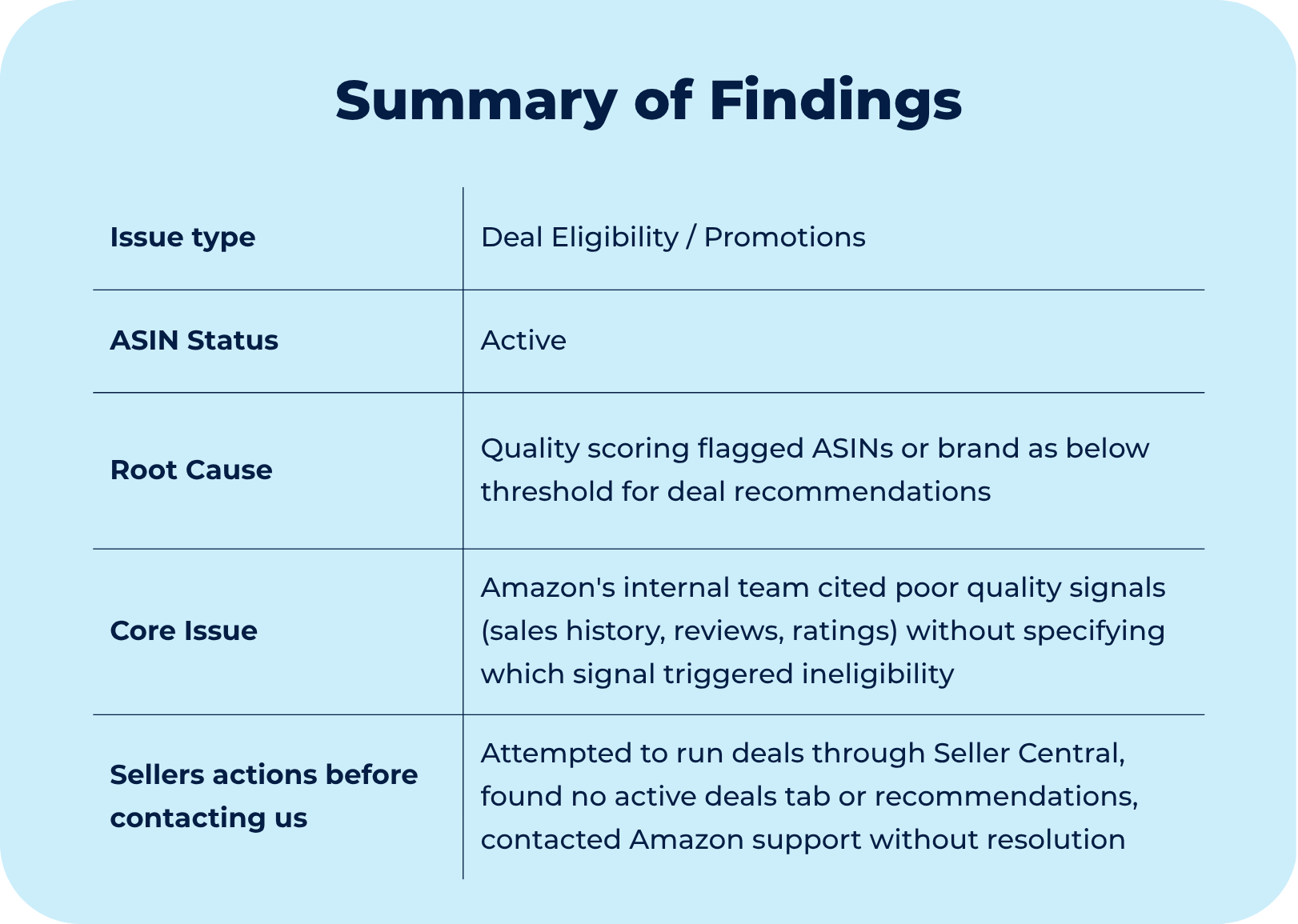
What it revealed instead was a structural condition that operators rarely encounter and are even less prepared to navigate: a backend quality designation applied to an account or brand that the seller cannot see, cannot directly dispute through Seller Support, and that Amazon’s internal teams will decline to override even after formal escalation.
Diagnostic
Two eligibility layers. One seller view.
Amazon’s Deals program operates across two distinct eligibility layers, presented to sellers as a single unified system, and the gap between the presentation and the reality is crucial to understanding this case.
The first layer is the published checklist, which the sellers should monitor, and the one that the Troubleshooter evaluates. It includes:
Minimum seller account rating of 3.5 stars
Minimum product rating of 4 stars
Active listing status
A validated reference price
Compliance with fulfillment performance thresholds for seller-fulfilled orders
and category restrictions that exclude entire product types.
When all these conditions are met, it is reasonable to expect that deal recommendations will appear in the Deals Dashboard.
The second layer is an internal quality scoring model that operates independently of the checklist, is not visible to the seller, and is not evaluated by the Troubleshooter.
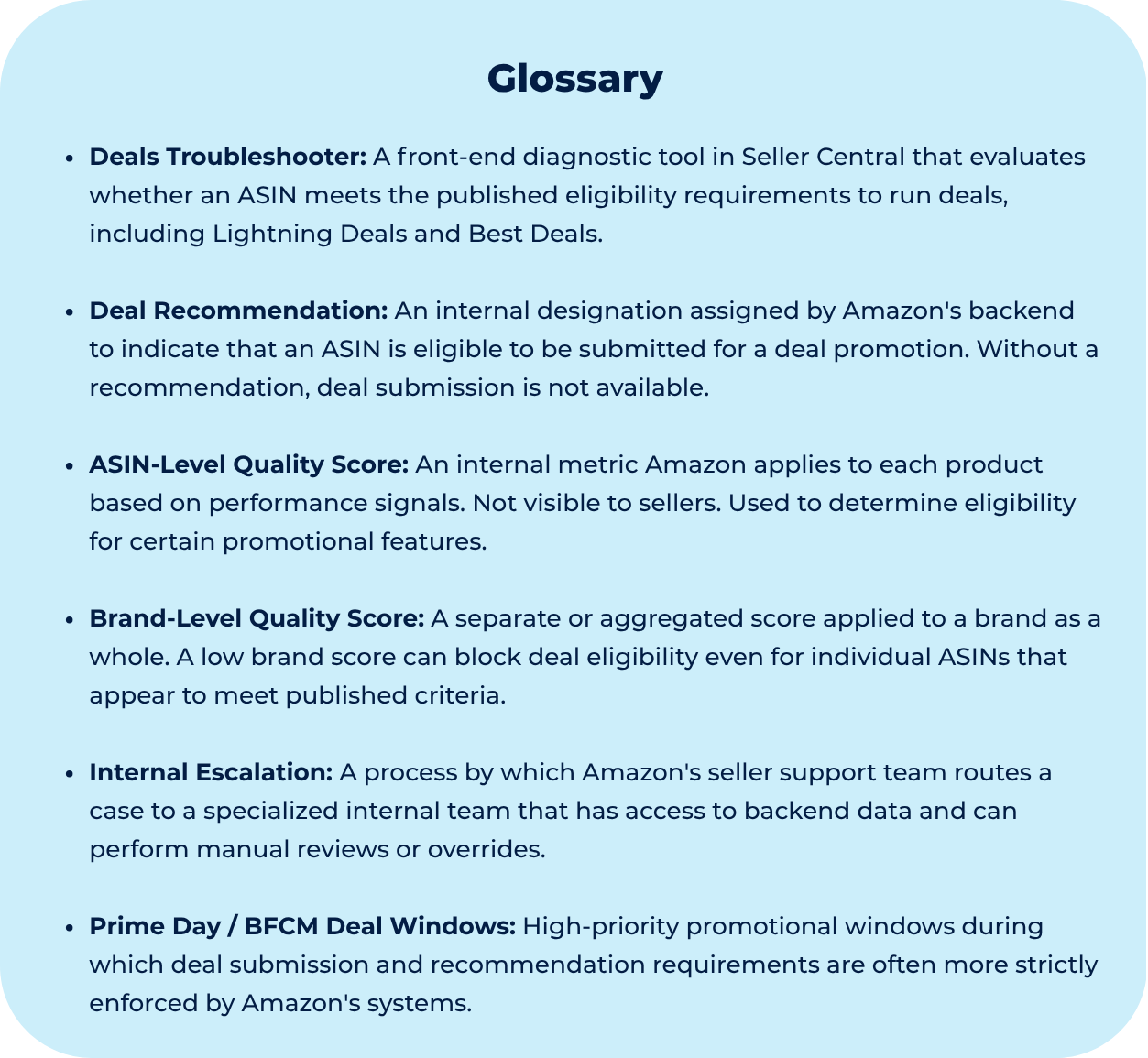
Amazon applies this model at the ASIN level and at the brand level, drawing on signals such as sales history, review volume, star rating, and available inventory. The exact weighting of those signals and the threshold required to receive a recommendation are not disclosed. If the score falls below that threshold, no recommendations are issued, regardless of whether all published criteria have been satisfied.
Amazon’s policy documentation acknowledges this condition in a single sentence near the bottom of the product eligibility section, after the checklist has been presented:
“Even if they meet these criteria, some ASINs might not receive a recommendation due to additional factors.”
That sentence is the operative condition for a significant number of accounts that are denied deal access without a clear explanation, and it functions as a disclosure that the checklist is necessary but not sufficient.
In this case, the response received from Amazon’s internal team after escalation read:
“ASIN is not currently eligible for Deal Recommendations due to the ASIN (or Brand) being poor quality (low or not enough sales history, reviews, ratings, etc.).”
No specific metric was cited, no threshold was shared, and no comparison to the account’s actual performance data was included. The system returned a category label rather than a measurement, meaning there was no specific value to correct and no defined target to reach.
If your account is blocked from deal recommendations and the Troubleshooter returns a clean audit, the block is likely in the second eligibility layer.
We can review your account and manage the escalation sequence on your behalf.
Though Process
What the policy actually says versus what the interface implies
When we did the front-end audit, it all came back clean across all published criteria, and that result was itself diagnostic: a clean audit means the block is not in the published eligibility layer, which changes the direction of every subsequent action.
A standard response at that point would have been to open a support case requesting deal reactivation, but that path treats the Troubleshooter as the complete picture of eligibility, and the policy does not support that reading.
That closing sentence in the policy documentation (in the diagnostic), the one acknowledging that additional factors can prevent recommendations even when all criteria are met, reframes everything the checklist implies.
Passing the Troubleshooter confirms the account has not been disqualified on published criteria, it does not confirm that the backend has issued an invitation.
Once that distinction was established, the diagnostic question changed from “what requirement is unmet?” to “which layer is making this decision, and does that layer have an accessible appeal path?”
The response from Amazon’s internal team, a quality-flag label with no supporting metric, confirmed the block was in the second layer and that standard support lacked the visibility or authority to address it.
The capacity variable Amazon introduced in its final response is also worth reading against the policy. The documentation states that recommendations are refreshed weekly and that an eligible ASIN one week may not appear the next, language that implies a dynamic allocation system rather than a static gate. That framing means the program has two independent constraints operating simultaneously, quality scoring and category capacity, and clearing one does not guarantee clearing the other.
