

Case #021 - ⚖️ The algorithm flagged it while the law exempted it
A product exempt from EPA registration kept triggering Amazon's compliance system, but the ingredients were legal, and the label was correct, the system is still blocked in California.

If you’re new here, welcome.
If you’ve been reading for a while, thank you for being here.
Each week, we break down one real Amazon case from the field. Not to share tactics, but to decode how Amazon’s system actually behaves and what to do when it breaks.
All past cases live in a single searchable archive, built to help you identify recurring patterns across time.

Context
A compliant product blocked by a policy
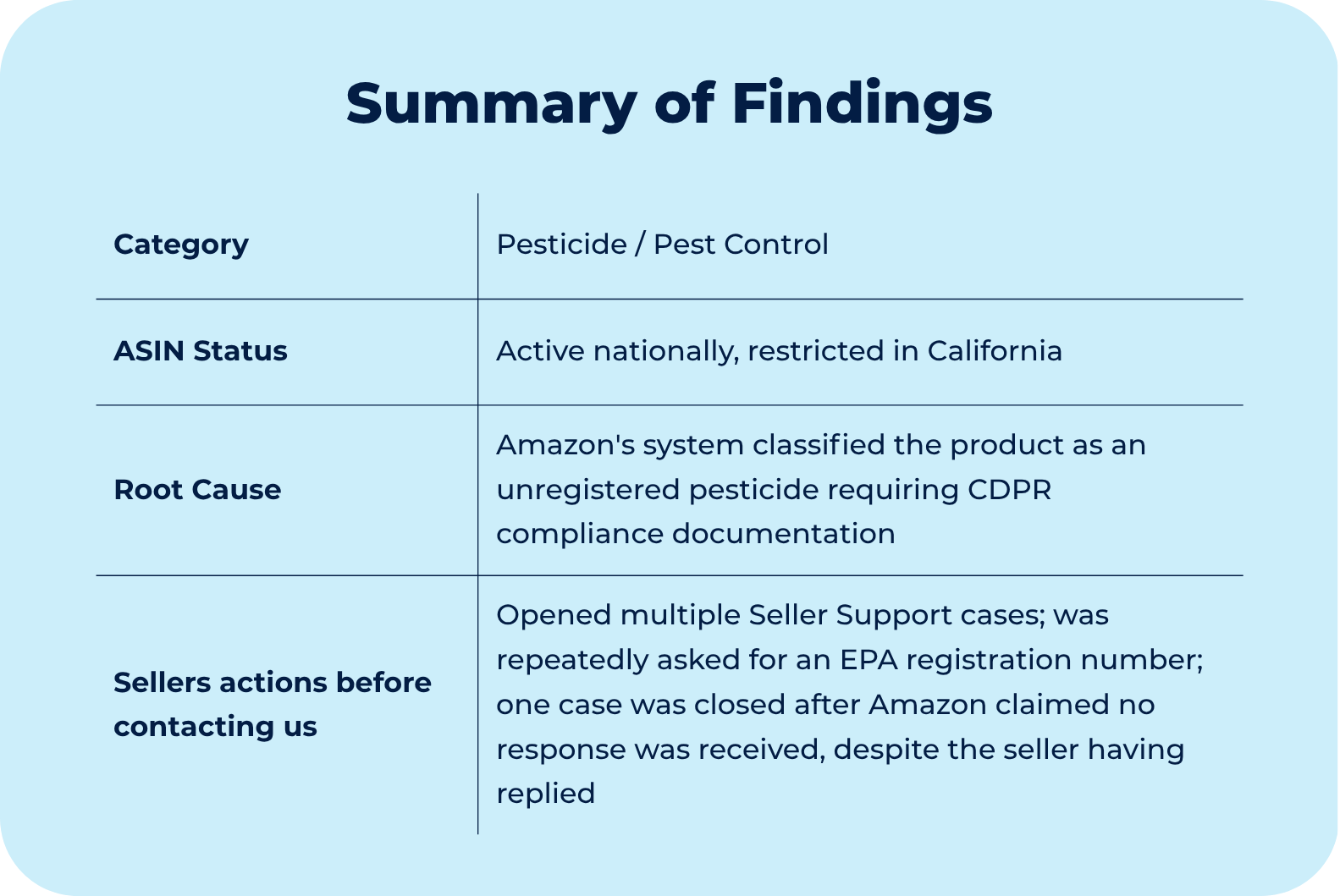
A seller listed a lime-based pest-control product under multiple ASINs on Amazon.
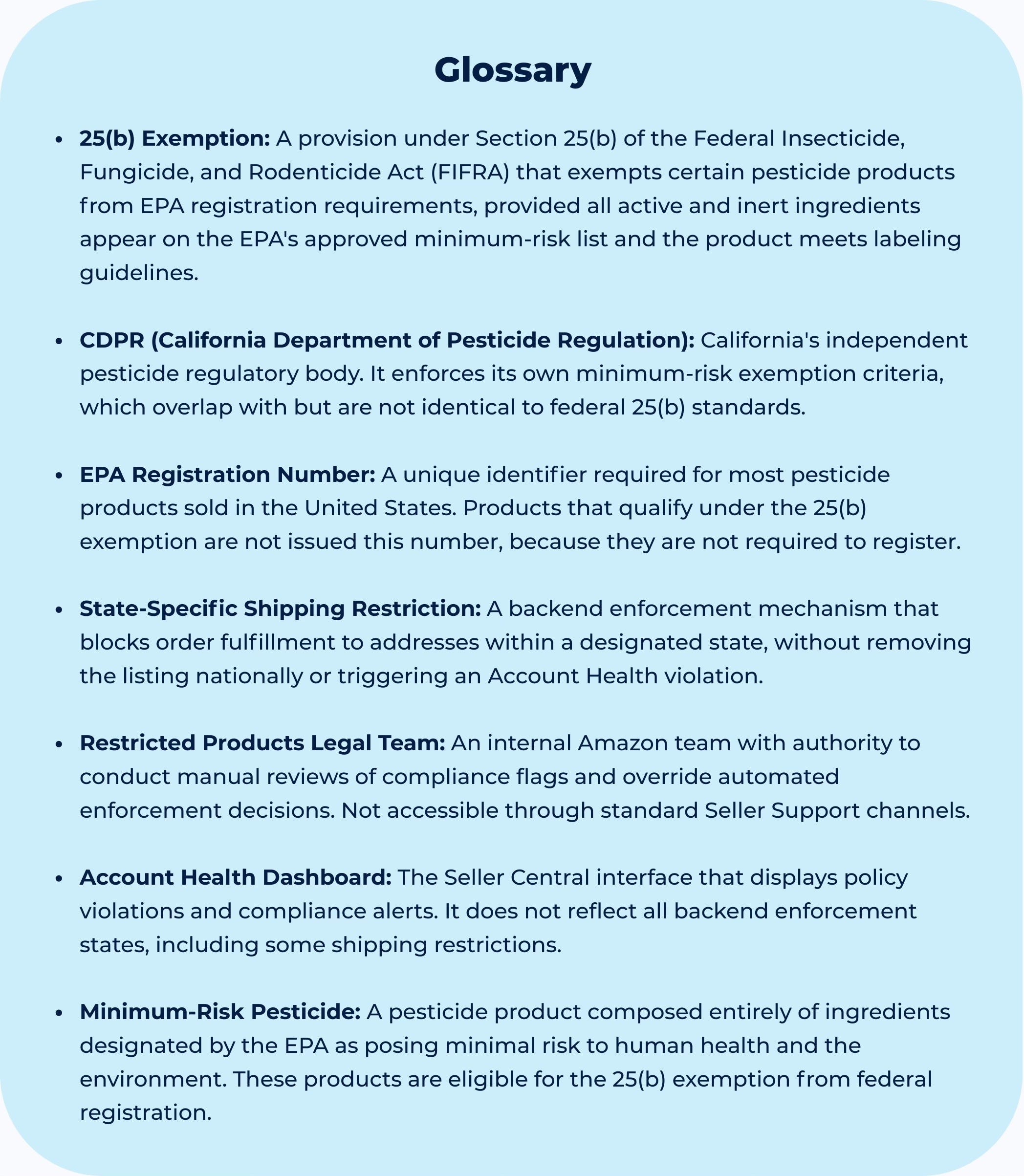
Let’s say, for example, that the active ingredient was citric acid and the inert ingredient was calcite. Both appear on the EPA’s approved list for minimum-risk pesticides under Section 25(b) of the Federal Insecticide, Fungicide, and Rodenticide Act (FIFRA).
Under that exemption, products formulated exclusively from approved ingredients are not required to obtain an EPA registration number, because the federal government has already determined they pose minimal risk.
The seller’s logic was sound, the product was compliant at the federal level, but California has its own pesticide oversight body, the California Department of Pesticide Regulation (CDPR), and it maintains its own criteria for minimum-risk pesticide exemptions, criteria that largely mirror the federal standard but are enforced independently.
The seller believed that federal 25(b) status was sufficient to sell in all states, including California.
Amazon’s system did not agree, and a compliance flag was applied to their ASIN, generating a state-specific shipping restriction that prevented the product from being purchased or delivered to California addresses.
Luckily, the restriction did not remove the listing entirely or suppress the ASIN nationally, it only targeted one state, through one policy trigger, enforced at the backend level.
Worth keeping in mind: The seller contacted Amazon Support and was repeatedly asked to provide an EPA registration number, even when the product does not have one, since it is exempt from registration (That exemption is precisely what the 25(b) designation means).
Diagnostic
Two systems, one product, no shared memory
A policy flag was applied to this ASIN, and that flag is the output of an automated compliance scan that cross-references product category signals, ingredient claims, and listing metadata against Amazon's internal pesticide policy framework.
When the scan identifies a product that appears to be a pesticide without a verifiable registration record, it applies a state-level shipping restriction for California, the state with the strictest independent pesticide oversight in the country.
The problem with Amazon’s compliance system is that it is designed to resolve pesticide flags through one of two pathways: either the seller submits an EPA registration number, or the product is not sold.
The 25(b) exemption creates a third condition that the automated pathway was not designed to accommodate. Exempt products are, by definition, not in the EPA’s registration database. So when the system queries for a registration number and finds none, it treats the absence as non-compliance rather than as an indicator of exemption status.
This is not a policy error in the traditional sense, because the system is operating as designed. The design simply does not account for the regulatory category this product falls under.
If you are dealing with a state-specific shipping restriction on a pesticide or regulated product and the standard support pathway keeps requesting documentation you are not required to provide, we can help you identify the correct escalation path and build a case for a manual review.
Though Process
What the system needs vs. What it asks for
The most disorienting aspect of this case was that the system was asking for something that could not exist.
A 25(b) exempt product does not have an EPA registration number. Submitting one is not possible. Explaining that it is not possible through standard Seller Support channels yielded no result because the support workflow was built on the assumption that every pesticide either has a registration number or is non-compliant.
The decision not to continue engaging through standard support channels after the first two failed attempts was deliberate. Each additional case opened through the standard pathway consumed time, generated a paper trail of unresolved tickets, and trained the system to associate the ASIN with repeated compliance inquiries that went unresolved. Continuing that approach would have increased the risk of a broader enforcement action.
The escalation had to reach a team with the authority and the regulatory literacy to understand what a 25(b) exemption means in practice.
That team is Amazon’s Restricted Products Legal team. It cannot be reached through a standard support ticket. It requires a specific escalation path, precise framing of the regulatory argument, and documentation that shows the ingredients are individually approved under the EPA’s minimum-risk criteria.
The decision to lead with product images rather than written regulatory arguments was also intentional. The legal team cannot register a product or override a policy based on a seller’s claim of exemption.
They can, however, review label images and cross-reference the visible ingredient list against the EPA’s published approved ingredients.
