

Case #020 - 😬 Amazon decided your price is wrong and you can't prove otherwise
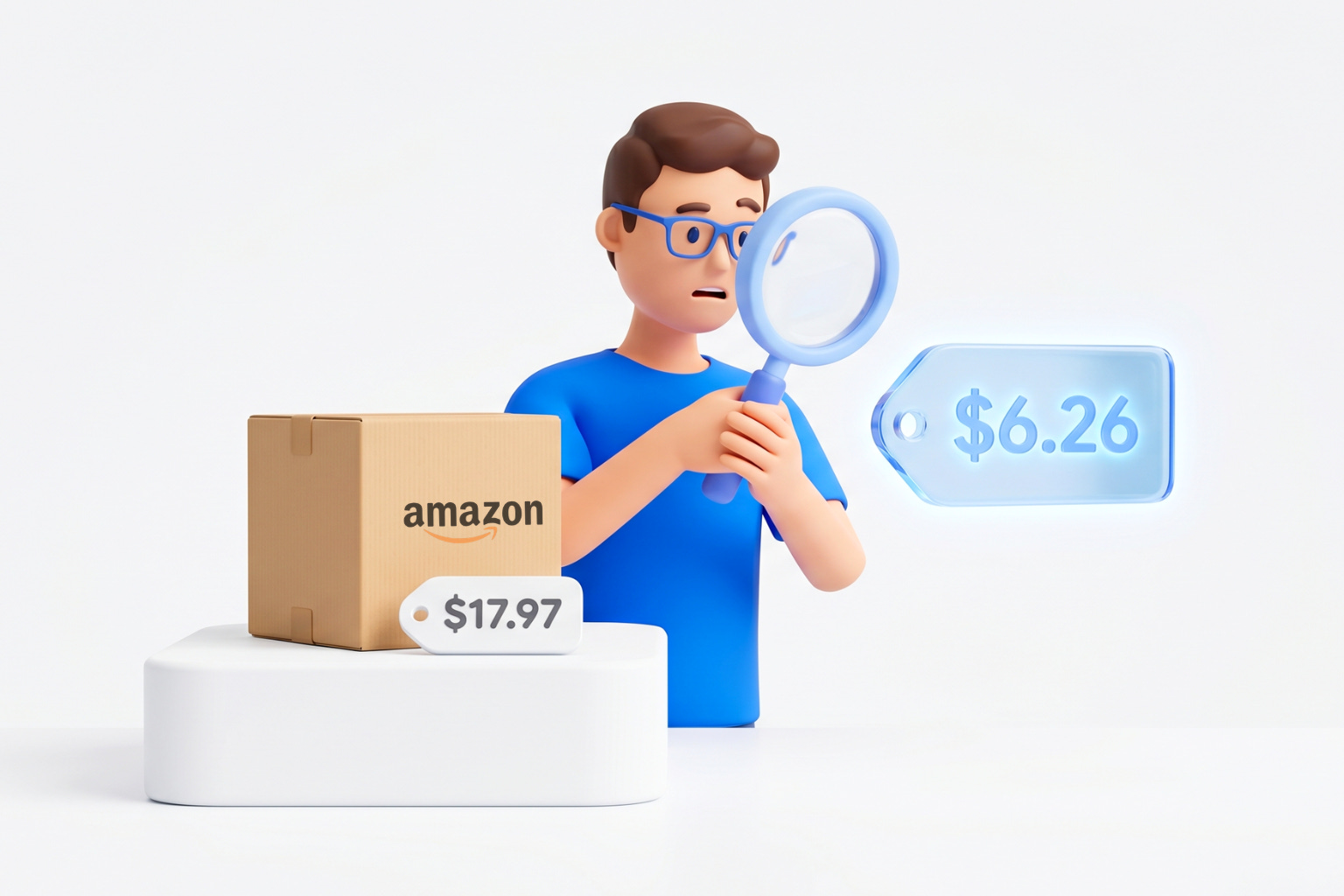
A listing restricted from the Featured Offer by an external price Amazon detected at $6.26, on a product sold exclusively on Amazon.

If you’re new here, welcome.
If you’ve been reading for a while, thank you for being here.
Each week, we break down one real Amazon case from the field. Not to share tactics, but to decode how Amazon’s system actually behaves and what to do when it breaks.
All past cases live in a single searchable archive, built to help you identify recurring patterns across time.
Context
A brand-exclusive listing, flagged externally
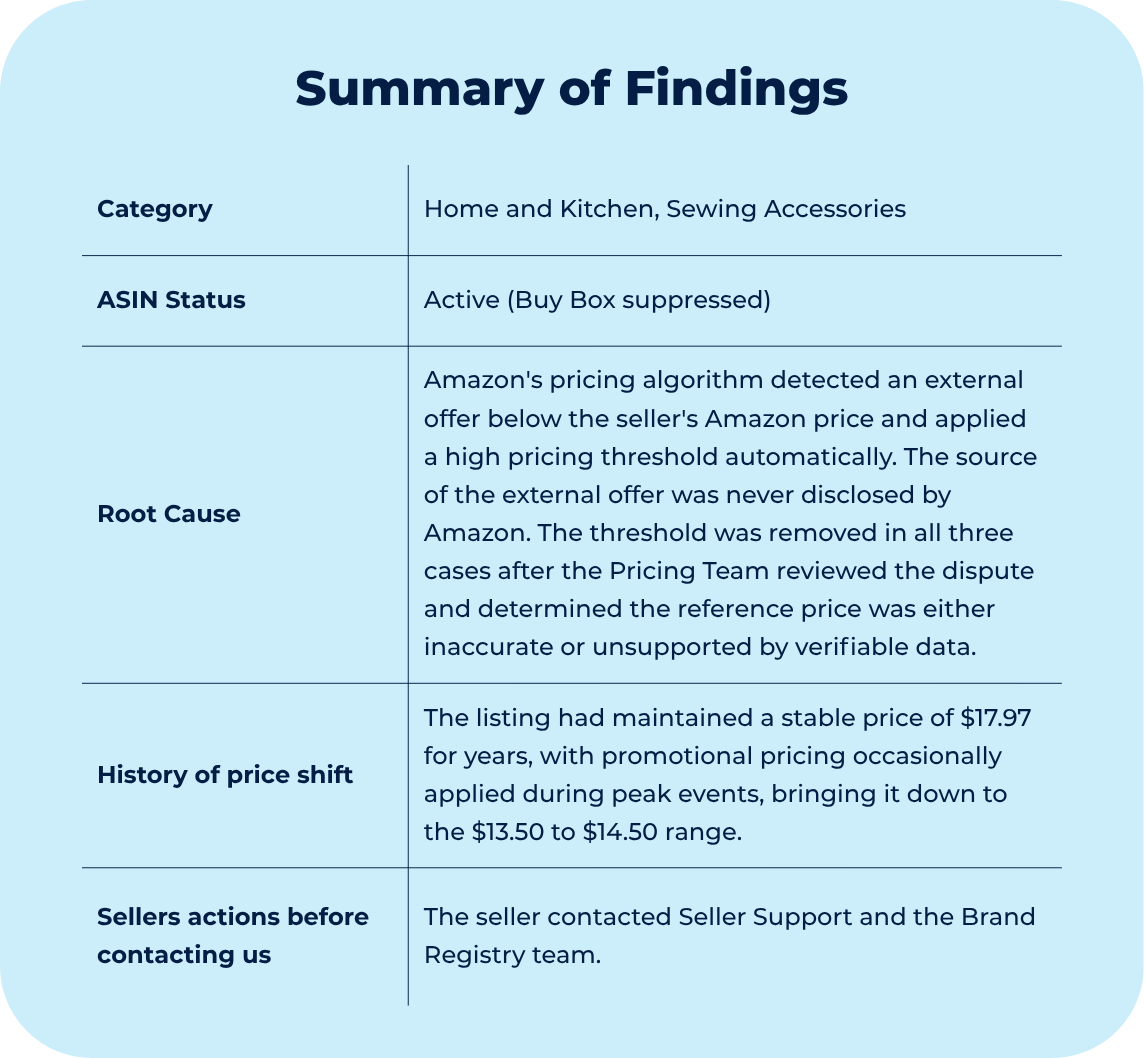
A listing lost Featured Offer (Buy Box) eligibility after Amazon applied high-price suppression based on a lower external competitive price it detected elsewhere, even though the seller had maintained the pricing for years, discounting only during peak events.
The seller behind the listing was a registered brand owner operating a single-channel business.
The thing is, the product existed only on Amazon, with no authorized third-party sellers and no presence on any other retailer, the catalog record was clean, the brand was registered, and the pricing history was stable.
From the seller’s perspective, the logic was sound: if you sell exclusively on one platform, no external competitive price can exist for your product. The assumption was that Amazon’s pricing algorithm would have nothing external to compare against, and the listing would remain fully eligible for the Featured Offer without interruption.
The seller contacted Seller Support and the Brand Registry team before reaching out to us, but neither channel was able to resolve or escalate it effectively. When the case came to Online Seller Solutions, the competitive price restriction was active, the Buy Box was suppressed, and no evidence package had been prepared.
Over the course of the engagement, the competitive price restriction was removed, reappeared at $6.70, was removed again, reappeared at $4.40, and was removed a third time.
Diagnostic
The algorithm does not verify exclusivity
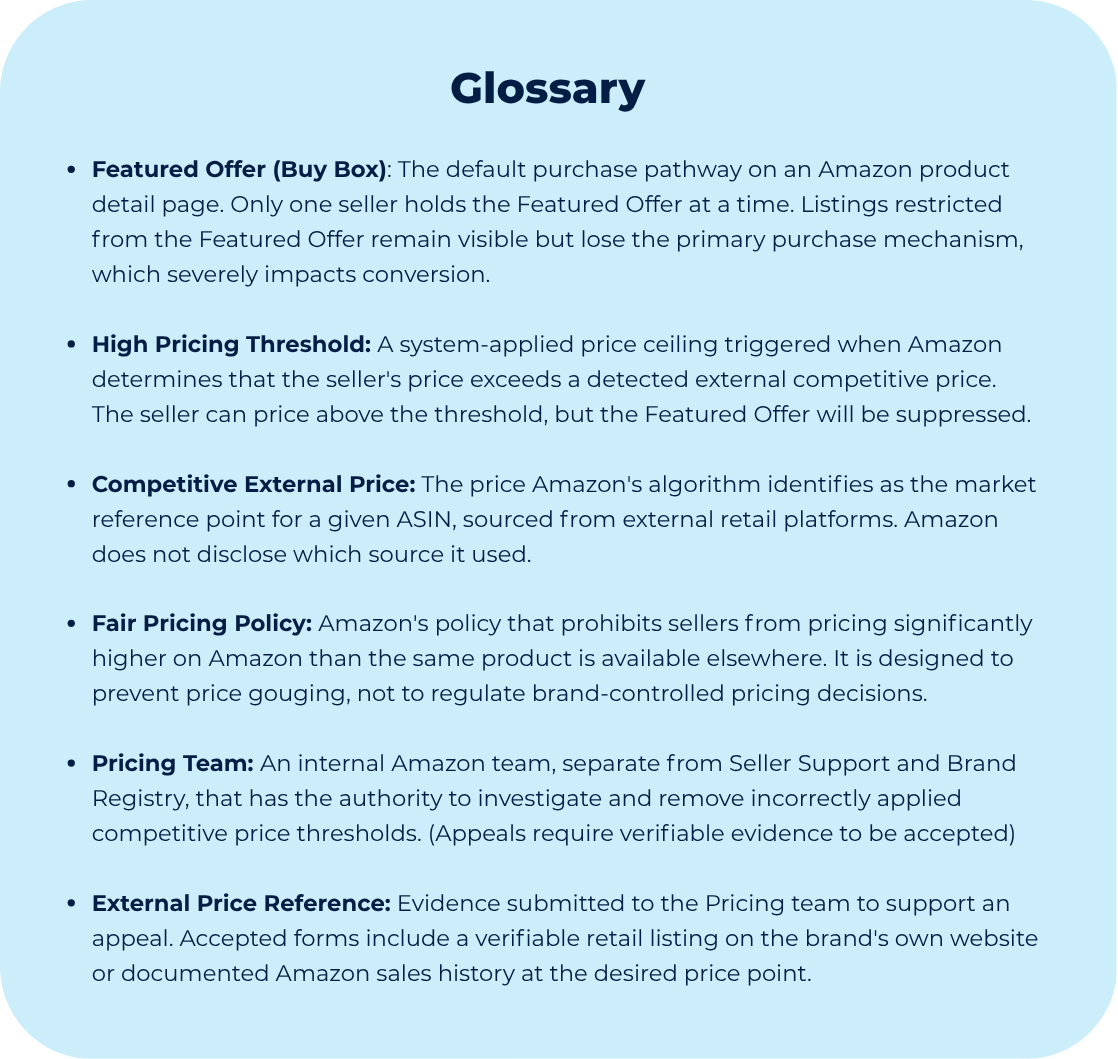
To understand why this became a problem, we first need to understand how Amazon’s Fair Pricing Policy operates: if a product is available for less elsewhere, the Amazon offer must be competitive (equal to or lower than) that external price.
The enforcement mechanism is a high pricing threshold, a system-applied ceiling that blocks the Featured Offer (Buy Box) when the seller’s price exceeds Amazon’s fair market price estimate based on external data.
The threshold is set automatically by an algorithm that scans external retail sources.
It is also worth knowing that the algorithm does not check whether the seller authorized those external offers, whether the brand sells exclusively on Amazon, or whether the detected external listing is for a new, used, or counterfeit unit.
It detects a price, compares it to the Amazon offer, and enforces the policy if the gap exceeds its tolerance.
In this type of case, Amazon does not disclose the specific source it used to establish the external competitive price, meaning the internal Pricing Team is the only channel with access to investigate whether the threshold was applied on valid grounds, while Seller Support and Brand Registry operate outside this authority and cannot intervene in pricing threshold decisions.
The critical separation here is between the catalog and the pricing enforcement.
Because at the end of the day, the pricing enforcement layer does not consult the catalog for ownership context. These are two independent systems, and a clean catalog record provides no protection against a pricing flag.
The recurrence pattern in this case, three separate episodes at three different price points ($6.26, $6.70, $4.40), confirms that removal does not suppress the algorithm, each time the algorithm detected what it considered a valid external reference price, it applied the threshold again automatically, plus the system has no memory of prior disputes, so everytime something like this happen is a reset.
If your listing is currently restricted from the Featured Offer due to a competitive price threshold, and Seller Support has not been able to move it, this is exactly the type of case we resolve at Online Seller Solutions to get you out of the restriction and the revenue loss that comes with it.
Reach out here and we will take it from there.
Though Process
Evidence first, escalation second
The first instinct when a pricing threshold appears is to contact the general Seller Support team.
That instinct is understandable, but it leads to a dead end in this category of issue, because Seller Support does not have access to the pricing enforcement, and also their tools fall short because they only show the flag, but they cannot remove it, meaning that escalating through that channel consumes time and creates a false sense of progress.
The next instinct is to dispute the flag by explaining brand exclusivity.
It sounds 100% logical: if the brand owns the product and sells only on Amazon, no legitimate external offer should exist, sadly the system does not process that argument.
The Pricing team requires evidence, since brand ownership is a catalog attribute, and the pricing algorithm does not cross-reference it.
With that being said, the key evaluative question before acting is: what evidence exists that the price Amazon flagged is incorrect, and can that evidence be made visible through a verifiable external source?
If the answer is no, the priority is to build that evidence before submitting any appeal. Submitting without it does not accelerate the resolution; it closes the pathway.
