

Case #014 - ⚠️ An Adult Category in Japan. A Suppressed Listing in the US.
A US-only seller's listings were suppressed by adult-product browse nodes they never created, in marketplaces they never actively entered.

If you’re new here, welcome.
If you’ve been reading for a while, thank you for being here.
Each week, we break down one real Amazon case from the field. Not to share tactics, but to decode how Amazon’s system actually behaves and what to do when it breaks.
All past cases live in a single searchable archive, built to help you identify recurring patterns across time.

Context
Looking at the right place but the wrong marketplace.
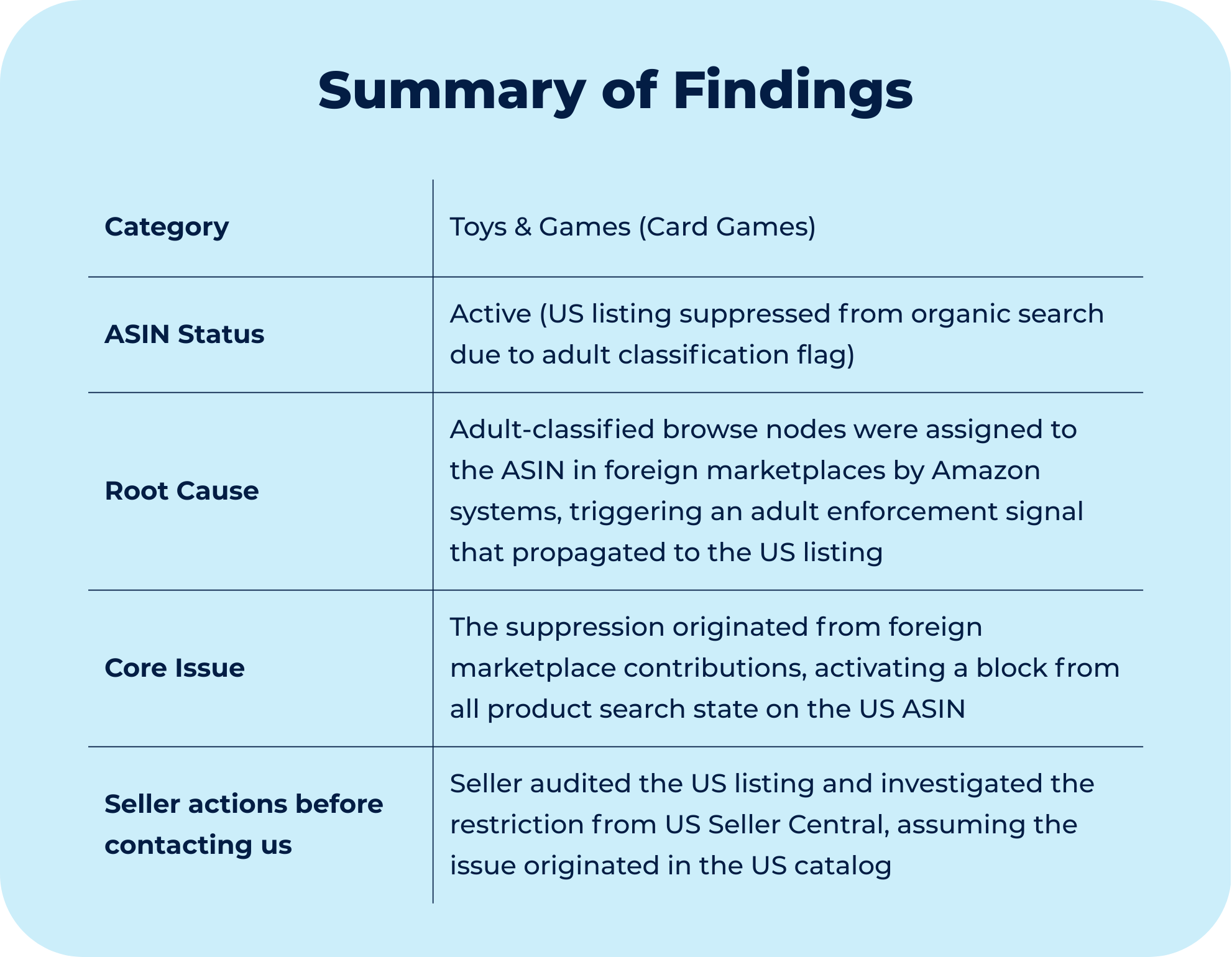
Our client had two ASINs under the same brand that lost search visibility in the US. Both were card game products, correctly categorized in the US within the browse node path.
No content had changed. No policy violation had been filed. From inside US Seller Central, the listings carried an adult restriction flag and were no longer appearing in organic search results.
The seller’s first assumption was reasonable: if the flag is on the US listing, the cause must be in the US catalog. Their products were active in the United States and Canada only. They had no accounts open on other marketplaces, had not submitted listings to those regions, and had not authorized any international catalog activity.
Looking at the US side of the problem was the logical starting point.
That assumption was incorrect, and the gap between what the US interface showed and where the problem actually lived is the core of this case.
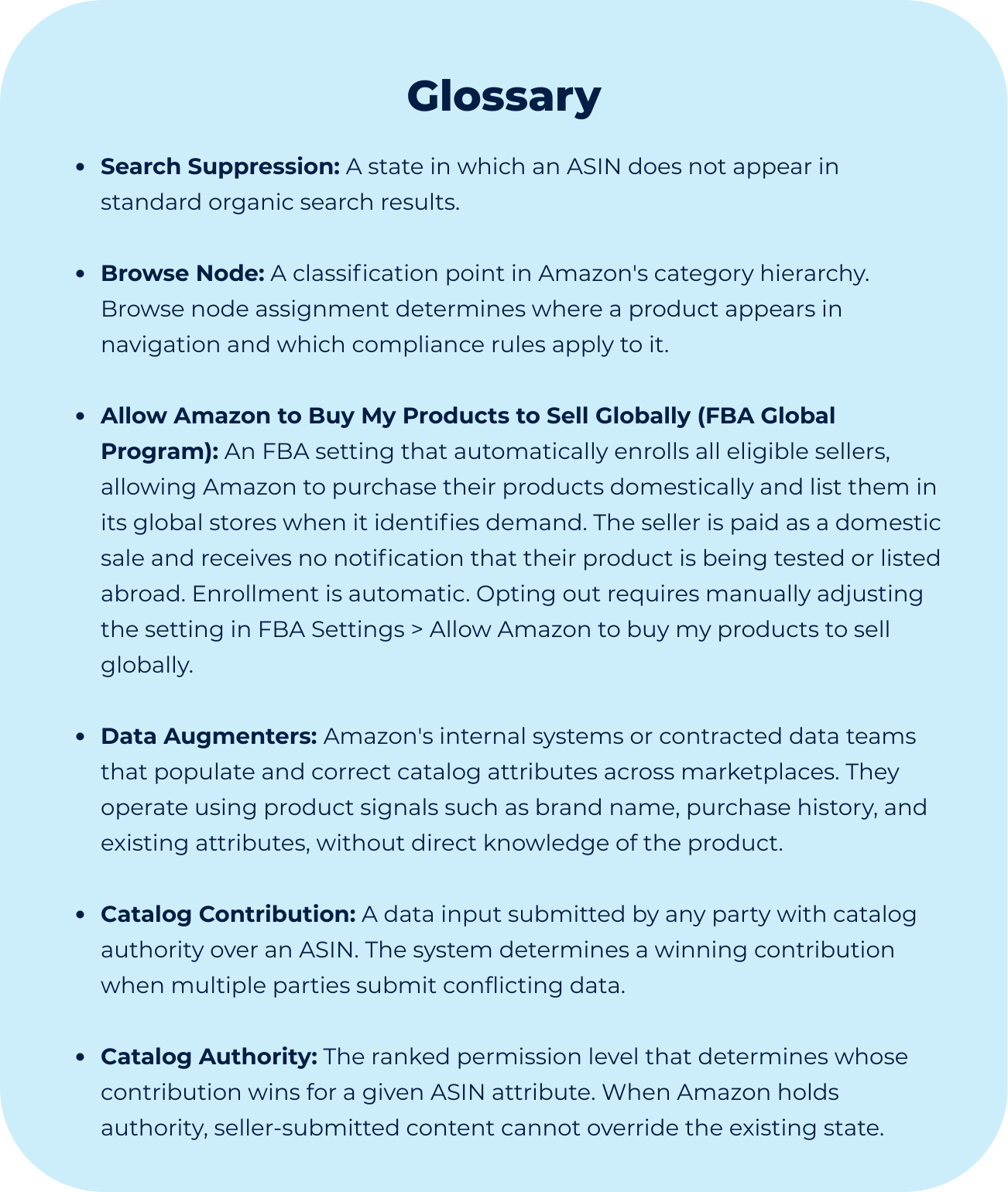
What the seller did not fully account for was that within Amazon’s FBA settings, there is a program called “Allow Amazon to buy my products to sell globally,” which I sometimes call “Global Listings.” All eligible FBA sellers are automatically enrolled upon account creation.
Under this program, Amazon purchases the seller’s products domestically and lists them in its global stores when it identifies demand or wants to test the product in those markets. The seller is paid as if it were a domestic sale. The customer receives the product as if they had ordered locally. The seller takes no action, receives no notification that their product is now listed abroad, and often has no awareness that the program is running at all.
Also, keep in mind that sellers do not need to actively list or sell in those regions for the accounts to exist and for ASINs to appear in those marketplaces’ catalog, whether through the Build International Listings tool or through automated catalog propagation triggered by Brand Registry and global selling infrastructure.
What they also did not account for is that product catalog data is not siloed by marketplace. A browse node contribution made in any marketplace, by any contributor with catalog authority over that ASIN, can propagate to and influence the product’s behavior in the US.
Diagnostic
How a foreign browse node reaches a US listing
Once we understood that Amazon was operating these ASINs in foreign marketplaces through International listings, the next question was: what had Amazon’s systems actually done with those listings?
After a lot of research, we found that Amazon held the retail offer in Australia, Singapore, and Japan, and those markeplaces where causing the suppression due to a category mismatch, which gave us the starting point. The foreign marketplace listings existed. Amazon was the seller of record. That meant Amazon’s internal catalog systems, not the brand, had the authority to assign browse nodes in those markets. The audit confirmed what those systems had done.
Identifying the source requires manually checking each marketplace one at a time, a process that is both slow and unreliable when the contributing marketplace is not one the seller is aware of.
The affected ASINs were placed in the following adult-classified browse nodes:
Australia: Health, Household and Personal Care > Sex and Sensuality > Novelty and Games
Singapore: Health, Household and Personal Care > Sex and Sensuality
Japan: Health and Personal Care > Sexual Wellness > Novelties
Each of these placements was made by Data Augmenters: Amazon’s internal systems or teams responsible for populating catalog attributes across marketplaces when Amazon holds the retail offer. Data Augmenters do not have direct product knowledge. They infer classifications from available signals, including brand name, historical purchase behavior, and the demographic profile of the buyer base. In this case, the brand name, combined with the purchase history and buyer profile of the product, produced signals that pointed the system toward sexual wellness classifications rather than the correct card game path.
Each misclassified browse node generated a catalog contribution that Amazon’s system read as adult product classification. The result was the activation of a block_from_all_product_search enforcement state on the US listing.
The US interface did not reflect the origin of the problem. In US Seller Central, the listing showed an adult restriction flag with no indication that the source was from a foreign marketplace. The contributing browse nodes were only visible by auditing each affected marketplace’s catalog state directly. The symptom was in the US. The cause was in three other countries, placed there by a program the seller did not know they were enrolled in.
The enforcement path ran in one direction only: foreign browse node assignment > global catalog flag read > US search suppression. Correcting the US flag required correcting the foreign browse nodes first. There was no shortcut through the US side of the catalog.
Most sellers focus on what appears on the product page. Amazon’s systems read much more than that.
When backend attributes are incomplete, the catalog begins inferring signals from other sources. That is often where misclassification starts.
If you already have optimized content, we can help upload your optimization through flat files and populate the backend attributes correctly, so the catalog does not have to guess what your product is.
Though Process
Why did we not start with the US
The Diagnostic established that the suppression flag had a foreign origin and that Amazon held catalog authority in those markets. That finding determined the entire resolution strategy.
The first instinct in most suppression cases is to audit US-side attributes. That instinct is correct as a starting point, but it can become a trap if the investigation stops there.
Before submitting any US-side content correction, the following question needs to be answered: Is the suppression originating from a US catalog contribution, or is it a downstream effect of a flag that was set elsewhere?
In this case, acting on US content first would have produced no result. The suppression was not caused by a US attribute. Submitting flat file updates to US content, or opening cases against the US listing, would have left the foreign browse node contributions intact, and the suppression would have persisted.
The correct evaluation path was:
Confirm the exact enforcement state for the ASIN (adult restriction or search suppression flag).
Audit the ASIN’s browse node assignments across all marketplaces where the ASIN is in the catalog, not just those where the seller is actively selling.
Identify which marketplace holds the contributing browse node that is generating the flag.
Determine who holds catalog authority in that marketplace. In this case, Amazon held the winning contribution on the foreign marketplaces, meaning the seller could not simply overwrite the browse node via a standard flat-file upload.
Design the correction to address the foreign marketplace contribution directly.
The decision not to open a US case first was deliberate. Opening a US case without resolving the source contribution would have added process overhead without addressing the root cause.
Additionally, because Amazon held catalog authority in the foreign marketplaces, the correction path required marketplace-specific case submissions requesting browse node synchronization, not seller-side content pushes. This distinction between seller-controlled contributions and Amazon-controlled contributions is one of the most important variables in any suppression case.
