

Case #013 - 🔐 You Think you Own your Listing?
A brand enrolled in Brand Registry could not update their own listings. The contribution map told us exactly why.
If you’re new here, welcome.
If you’ve been reading for a while, thank you for being here.
Each week, we break down one real Amazon case from the field. Not to share tactics, but to decode how Amazon’s system actually behaves and what to do when it breaks.
All past cases live in a single searchable archive, built to help you identify recurring patterns across time.

Context
Why the seller’s assumption was reasonable
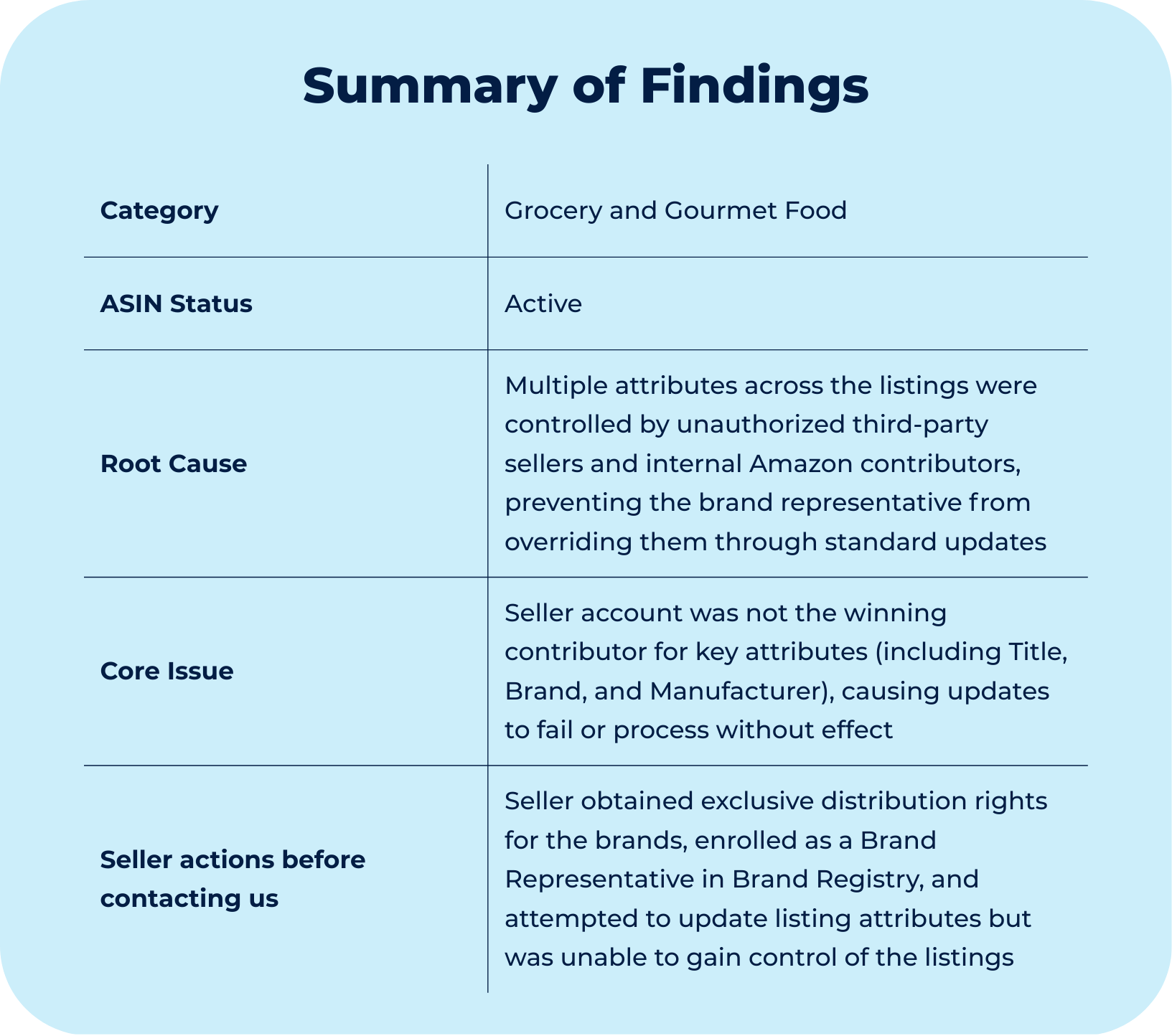
The seller held exclusive distribution rights for two brands and had been enrolled as a brand representative through Amazon’s Brand Registry program. Their goal was direct: take control of five existing listings, upload new images, and update product attributes to reflect accurate and current information.
Brand Registry exists precisely to give brand representatives elevated contribution authority over unauthorized third-party sellers. Expecting that Brand Registry enrollment would allow them to control the listings was not an unreasonable assumption. It is one of the program’s intended outcomes.
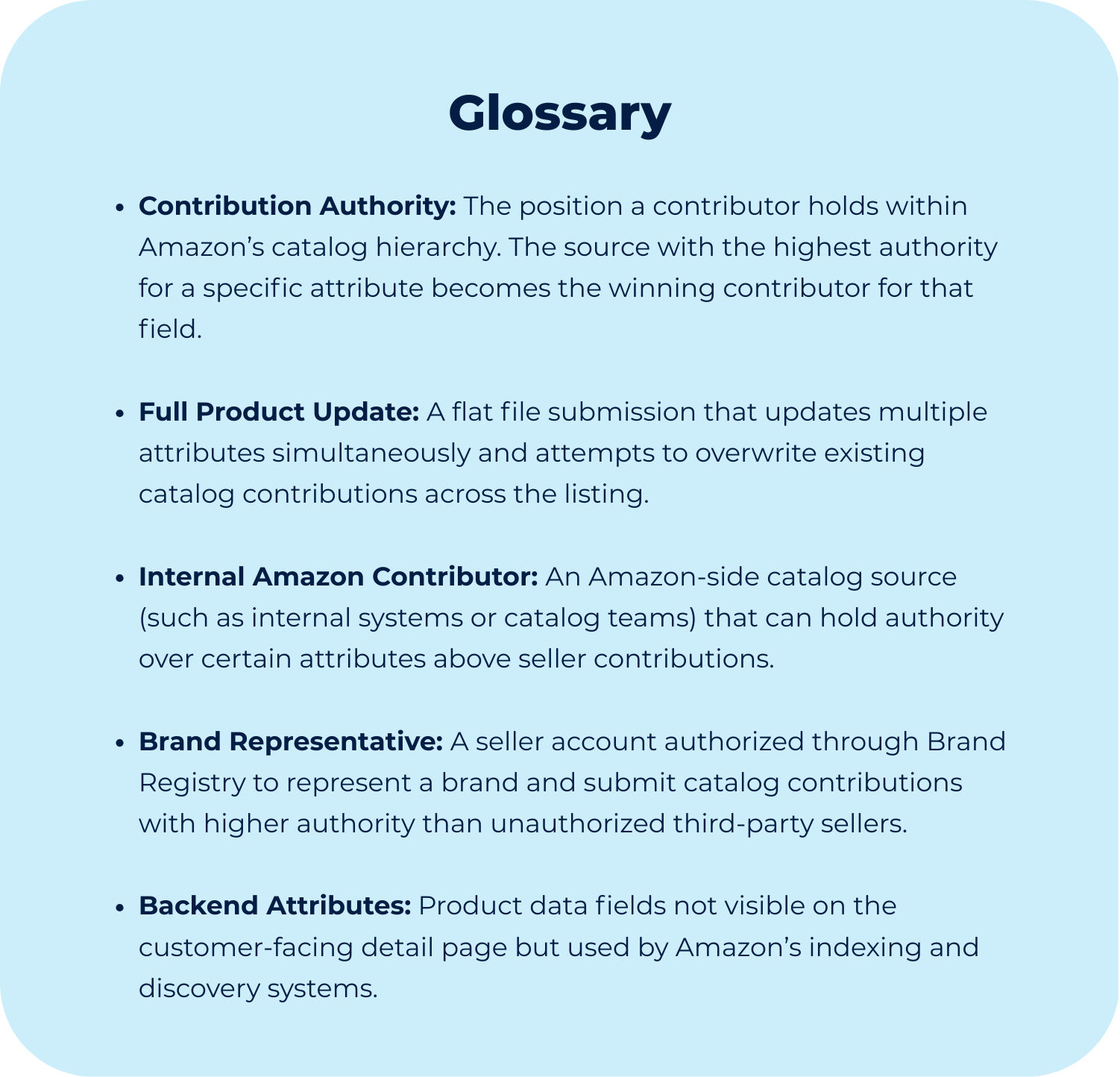
What the seller did not account for was that Brand Registry elevates a contributor’s authority above other sellers, but it does not place that contributor at the top of Amazon’s catalog hierarchy. Some attributes can still be controlled by internal Amazon contributors, which operate above seller-side contributions.
During the investigation, several attributes across the five ASINs were found to be controlled by a combination of unauthorized third-party sellers and internal Amazon contributors. Two of the listings contained attributes held by internal contributors, including critical fields such as the title, brand, and manufacturer.
At the same time, many backend attributes across the listings were incomplete. These fields are not visible on the product detail page but are used by Amazon’s discovery systems, including COSMO (its contextual search engine) and Rufus (its AI shopping assistant), to interpret product information and determine when a listing should appear in relevant queries.
Because contribution ownership varies by attribute, the seller had no visibility into which fields they could override and which ones were locked by higher-authority sources. Determining that required a contribution audit across all attributes for the five listings.
Diagnostic
Three contributors, three different problems
Once the contribution ownership map was assembled across the five listings, the attributes fell into three distinct categories. Each required a different resolution path. Treating them as a single problem is one of the most common operational mistakes in cases like this:
Category 1: Third-party seller contributions
Across all five listings, the majority of front-end and backend attributes were contributed by sellers without brand representative status. This included bullet points, product descriptions, images, backend keywords, and most structured product data fields.
This behavior is consistent with Amazon’s catalog system. In the contribution hierarchy, unauthorized third-party sellers hold a lower authority level than a brand representative, but they can still become the winning contributor when no higher-authority source has submitted a competing value.
In other words, these contributions were not the result of a violation or catalog error. The attributes simply remained under the control of whichever contributor had previously submitted them.
Category 2: Internal Amazon contributor controlling a title attribute
One of the listings had its title controlled by an internal Amazon contributor. Sources of this type operate above seller-side contributions in Amazon’s catalog hierarchy.
When an attribute is held by an internal contributor, seller-side updates can appear to process successfully but produce no visible change. The file is accepted by the system, but the existing contribution remains in place.
Because of this behavior, the only reliable way to confirm the outcome of an update is to verify whether the winning contributor actually changed after the upload.
Category 3: Internal Amazon contributor controlling brand identifiers
A second listing had the Brand and Manufacturer attributes controlled by an internal Amazon contributor.
These fields carry additional operational weight because they are used by Amazon’s catalog system to identify brand ownership and validate Brand Registry relationships at the ASIN level. When these attributes are held by internal sources, they can affect downstream catalog behavior, including how the listing is recognized and protected within the catalog structure.
Structural gap: Incomplete backend attributes
Independent of contribution ownership, every listing in scope also contained significant gaps in backend attributes.
These fields are not visible on the product detail page but are read by Amazon’s indexing and discovery systems, including COSMO and Rufus, to interpret product context and determine relevance.
Incomplete backend data does not trigger suppression, but it reduces the amount of structured information Amazon can use to understand the product.
As a result, listings may appear complete on the surface yet underperform in contextual search and AI-assisted discovery.
Many of these attributes also exist outside Seller Central’s standard editor. They are only accessible via flat-file submissions, which is where most structural listing implementations occur.
Understanding which attributes were controlled, which were incomplete, and which could be replaced through a Full Product Update required building the full contribution ownership map first.
When updates are processed but nothing changes, the issue usually isn’t the content. It’s the catalog structure behind the listing.
Seller Central shows only part of your listing. The rest lives in backend attributes, contribution ownership, and catalog permissions that most sellers never see.
If your listing isn’t responding to updates, the first step is understanding who actually controls those attributes.
Start with a flat file audit and a clear implementation plan.
Though Process
How did we map everything before acting
Before taking action, the diagnostic findings had to be evaluated against the assumptions most brand representatives bring into cases like this. The hypotheses below reflect that process.
Hypothesis 1: Brand Registry enrollment is enough to take control of all attributes
This is the starting assumption most brand representatives bring into situations like this. Brand Registry elevates the authority of contributions above unauthorized third-party sellers. If a brand representative submits a competing value, their contribution will typically replace those from lower-authority sources. However, if the brand representative has never submitted a contribution for a given attribute, the system simply keeps the existing one, even if it was originally submitted by a lower-authority seller.
Answer: Partially correct.
Brand Registry is sufficient to displace third-party seller contributions across most standard attributes. It is not sufficient on its own if other source types are involved. The enrollment status matters. It is not the complete picture.
Hypothesis 2: If an attribute does not update after a flat file upload, the file is likely incorrect
When a flat file processes successfully but the attribute does not change, the first assumption is usually that the file was structured incorrectly.
Answer: Incorrect in this case.
Attributes controlled by internal Amazon contributors can accept a flat file submission without generating an error while still leaving the existing contribution unchanged. In these situations, the issue is not file formatting but contribution authority within the catalog system.
Repeatedly uploading corrected files does not resolve the problem because the limitation is structural rather than technical.
Hypothesis 3: If an internal contributor controls an attribute, it cannot be changed from the seller's side
Another common assumption is that attributes held by internal Amazon contributors are permanently inaccessible to sellers.
Answer: Not always.
While internal contributors operate above standard seller submissions in the catalog hierarchy, their control is not always absolute. In certain cases, a properly structured Full Product Update submitted by a correctly enrolled brand representative can replace an internal contribution.
Whether that happens depends on several factors, including how the existing contribution was created and whether the attribute is actively maintained within Amazon’s catalog systems.
The question that leads to the solution
Given that three different contributor types were present across the listings, and that each responds differently to catalog updates, the correct question was not simply whether to submit a flat file.
The correct question was:
Which attributes can be replaced immediately through a Full Product Update
Which attributes require verification after submission to confirm that the contribution changed
Which attributes may require escalation if the internal contribution remains in place
Answering that required a complete contribution ownership map first.
Once that map was built, the execution sequence became clear.
The map determined the order of actions, and the order of actions determined the outcome.
