

Case #012 - 🚨 Selling on Amazon without a Ranking?
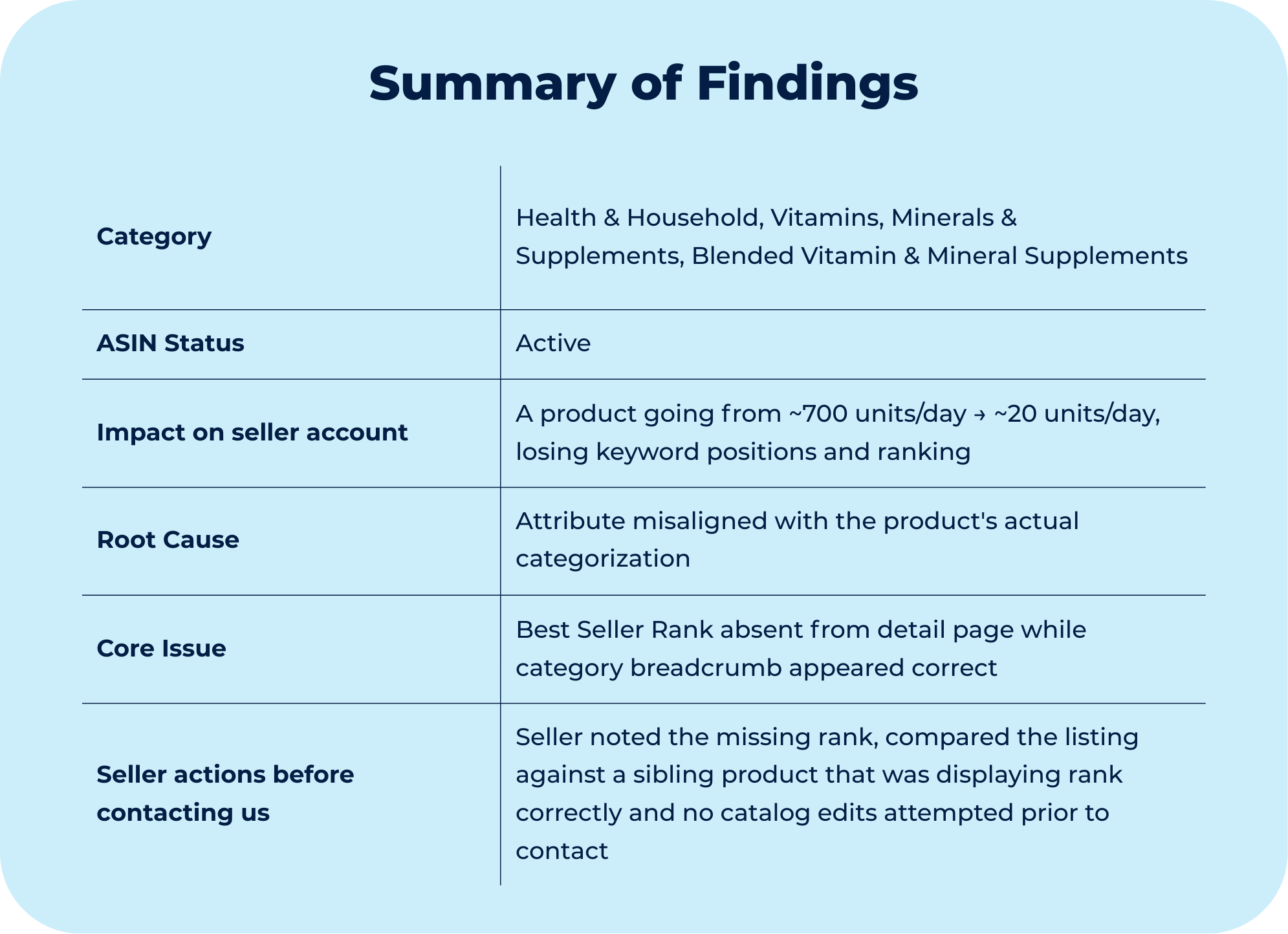
A selling ASIN with a correct category path, active sales, but without Best Seller Rank. The detail page showed nothing wrong.

If you’re new here, welcome.
If you’ve been reading for a while, thank you for being here.
Each week, we break down one real Amazon case from the field. Not to share tactics, but to decode how Amazon’s system actually behaves and what to do when it breaks.
All past cases live in a single searchable archive, built to help you identify recurring patterns across time.

Context
A correct page, and absent rank
Before the BSR disappeared, this client was moving roughly 700 units per day. By the time the case reached us, that number had dropped to around 20. A near-complete collapse of organic sales velocity, with no suppression notice, no policy action, and nothing on the detail page to explain it.
On Amazon, BSR is not just a number. It is a visibility signal. Products with stronger BSR appear higher in search results, attract more organic traffic, and carry social proof that influences buying decisions.
When rank disappears, organic traffic drops, conversion rates follow, and advertising spend has to increase just to replace the visibility the listing previously earned organically. For a product that had built its position through consistent sales performance, losing BSR meant losing the compound effect of everything that had been built.
The first instinct was that this might be a glitch. But it would resolve on its own. This did not. The rank was simply absent, persistently, with no accompanying error on any seller-facing surface.
To understand why that is possible, it helps to understand what BSR actually is. It is not a static value stored on a listing. It is a calculated output, updated hourly, based on historical sales volume, with recent sales weighted more heavily than older ones.
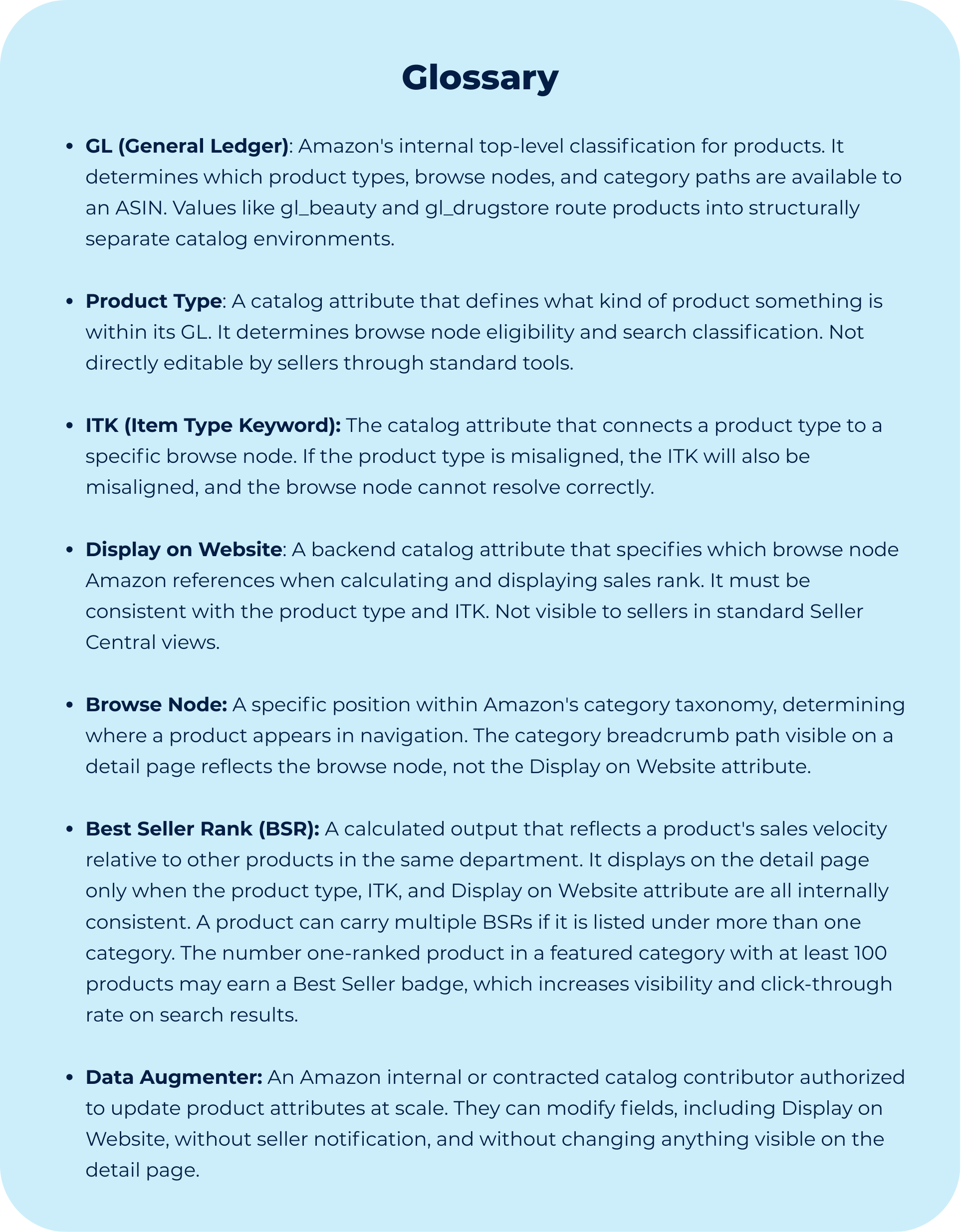
For Amazon to calculate and display a rank, three backend catalog attributes must align to the same marketplace department: the GL, the product type, and a field called “Display on Website”. Display on Website is the attribute that gives Amazon a reference point for calculating rank. If those three attributes do not align, Amazon has no valid path to complete the calculation. The rank does not appear while the listing continues to function normally in every other respect.
BSR is also relative: a product’s rank can drop even if its own sales increase, if competitors in the same category are selling faster. Only products with an active sales record in a featured category will display a rank at all.
Diagnostic
Where the rank calculation breaks
In this case, the product type was nutritionalsupplement and the ITK was health-and-personal-care. Both attributes pointed toward the Health and Household browse node, but the Display on Website attribute was not.
That mismatch is what stopped Amazon from calculating and displaying a rank.
What makes this hard to catch is that the detail page does not expose it. The category breadcrumb visible at the top of the listing reflects the browse node, not the Display on Website attribute.
Plus, those are two separate fields, and Amazon does not enforce that they stay in sync. One can change without the other following, so a seller looking at the listing sees the correct category path and has no signal that anything is wrong, meanwhile the rank calculation is failing in a layer that the detail page does not show.
The “Display on Website” attribute can be modified by Data Augmenters, like any other attribute. An incorrect edit to this field produces exactly the condition observed here: rank disappears without any seller-side action, the detail page appears unchanged, and nothing in Seller Central indicates a problem. The listing continues to sell. The failure is entirely silent.
A missing rank on an active, selling listing is rarely a glitch. When the detail page looks correct, and the problem persists, the answer is in the backend catalog. If you are dealing with this, you need a plan of action.
Though Process
Why the detail page was not the answer
The case opened with a straightforward question from the client: the ASIN was not showing its sales rank.
Treating it as a glitch and waiting was considered first. That path was set aside because the rank had been absent long enough to warrant investigation, so a structural explanation was more consistent with what was observed.
The next step was to assess what the catalog state actually was, rather than what the detail page suggested. The visible category path was correct. That ruled out a browse node problem at the surface level. The question shifted to what backend attribute could produce a rank failure while leaving the detail page intact.
Display on Website fits that profile precisely.
It is not visible in standard Seller Central views.
It is not reflected in the category breadcrumb.
It can diverge from the product type and ITK without producing any error.
And it can be changed by a party the seller has no visibility into.
Once that was identified as the probable cause and confirming that the current product type, ITK, and browse node path were correct, the goal was to arrive with a clear answer to the question: what should this ASIN’s attribute look like?
That’s what we evaluated with our client, and after checking each product from their brand and similar products from the catalog, we had that clear, so the next step was an escalation framed as a correction request for a specific attribute.
