

Case #011 - State-Level Shipping Restrictions on a Compliant ASIN
An ASIN for a pesticide became unavailable in many states even though it was federally compliant, registered with the EPA, and had been sold in those states for months.
If you’re new here, welcome.
If you’ve been reading for a while, thank you for being here.
Each week, we break down one real Amazon case from the field. Not to share tactics, but to decode how Amazon’s system actually behaves and what to do when it breaks.
All past cases live in a single searchable archive, built to help you identify recurring patterns across time.

Context
Invisible state-level blocks
Amazon enforces compliance on multiple levels at once. Most sellers are familiar with federal requirements such as EPA registration for pesticides, FDA approval for supplements, or CPSC compliance for children’s products. What many miss is that individual states can apply their own separate restrictions to the exact same ASIN, independent of whether federal requirements are met.
These state-level restrictions leave no obvious trace. Unlike federal flags, they do not appear in catalog health dashboards, trigger suppression notices, or generate violation emails. The only sign that something is wrong was that orders from certain states simply stop being fulfilled.
This pattern is more common in categories involving chemicals or materials regulated by state environmental or consumer safety laws.
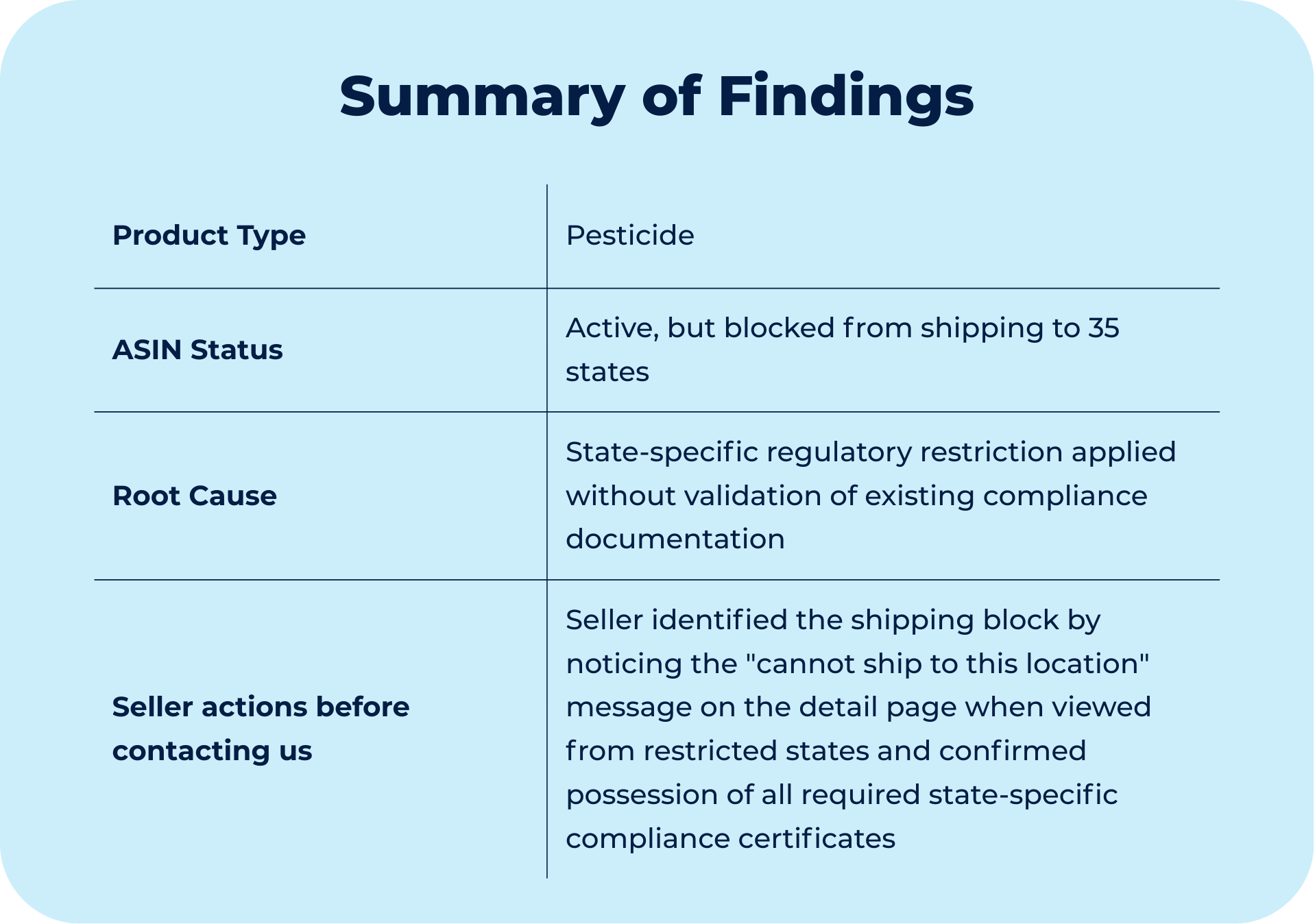
That is precisely what happened here. A pesticide ASIN was blocked from shipping to 35 states across every region of the country, even though the seller held every required state-level compliance certificate.
No violation was filed. No suppression event occurred. The product did not disappear from search results. Orders simply became impossible to fulfill in certain geographies.
Diagnostic
How Amazon applies state shipping restrictions
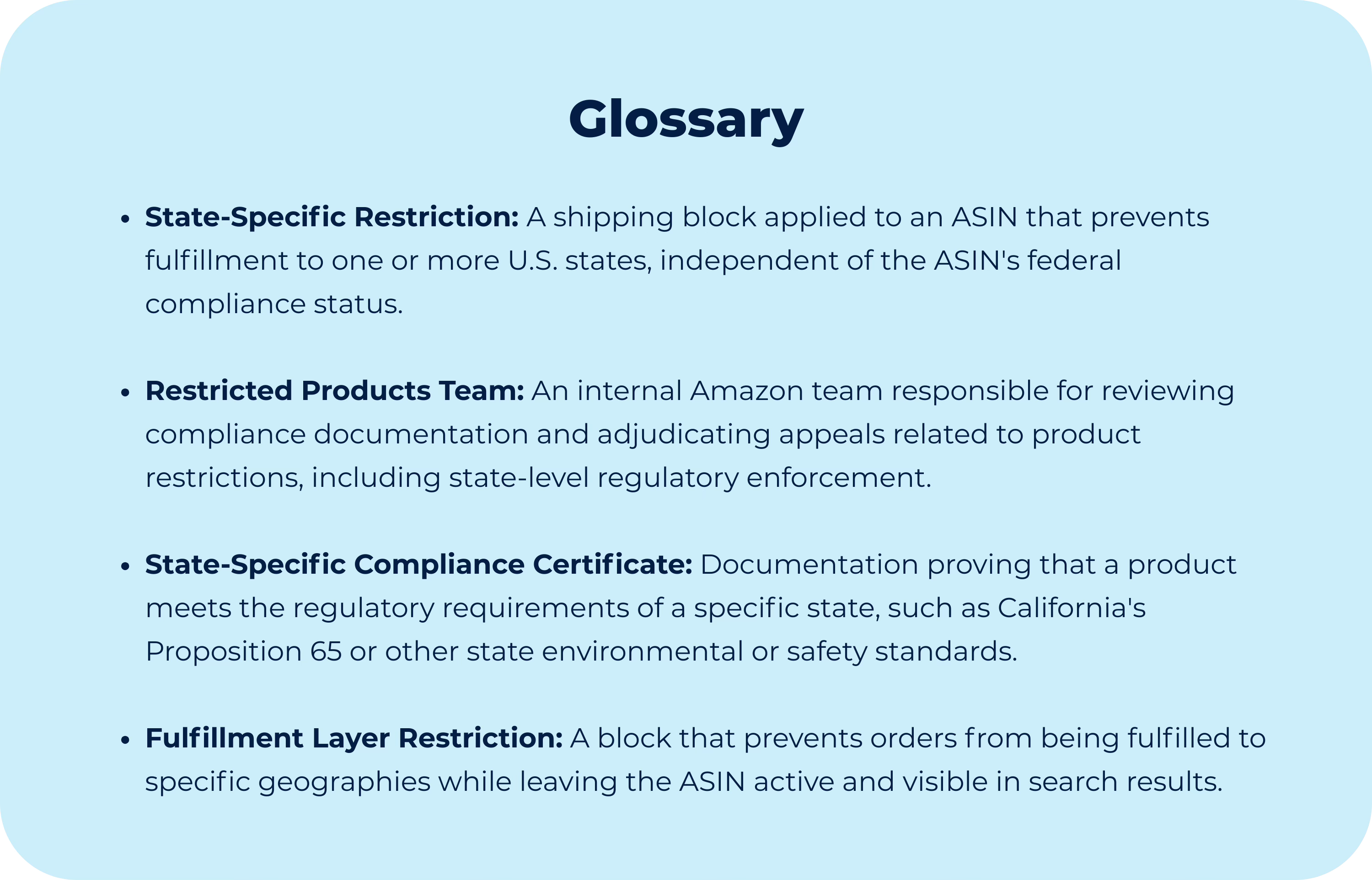
Amazon runs a separate enforcement system specifically for state-level regulations. When a product gets flagged (either by an algorithm or through manual review) as potentially subject to state-specific rules, the system immediately applies a shipping restriction to those states without checking whether the seller already has compliance documentation on file.
In this case, the ASIN was restricted in 35 states simultaneously, even though the seller already had all the required certificates for each jurisdiction.
The restriction applied to states with varying pesticide registration frameworks, including both states with rigorous requirements (NY, CA, FL) and states with less restrictive frameworks (SD, ND, WY). This suggests the system flagged the ASIN based on federal product category rather than individualized state-level risk assessment.
The restriction operates at the fulfillment level, not the listing level. This means the ASIN stays visible in search results, remains searchable, and can, in theory, be purchased. But when a customer from a restricted state tries to place an order, it cannot be fulfilled.
The restriction manifests on the customer-facing detail page. When a buyer in a restricted state views the ASIN, they see a notification that the product cannot be shipped to their location. But the seller receives no corresponding alert in Seller Central, and the ASIN shows as active in inventory reports.
The system enforces a specific documentation hierarchy. Federal compliance documents are insufficient because they do not address state-level registration rules. Each state requires its own certificate corresponding to its specific regulatory framework.
In cases like this, the hardest part is recognizing that the problem lives in Amazon’s state-level enforcement layer.
When Amazon blocks your ASIN from shipping to 35 states without any violation notice, you can either have our team handle the escalation and documentation review or spend weeks contacting Seller Support agents who don’t have the authority to remove the restriction.
Though Process
Why the system blocks first
The central question is this: why does Amazon restrict a compliant ASIN without first checking whether the seller already has the required documentation?
The answer comes down to how Amazon’s Restricted Products system prioritizes risk over efficiency. The system is designed to prevent non-compliant products from reaching customers, and it operates on the assumption that it is safer to block first and validate later.
The seller feels the impact of the restriction immediately: lost sales, blocked orders, and frustrated customers. But the opportunity to prove compliance only becomes available after the restriction has already been applied. Amazon does not proactively accept compliance documents. The seller must actively submit them through an appeal.
The system applies state-level restrictions based on product attributes or category signals, not on a manual review of the listing. If an ASIN is flagged as containing pesticides or chemicals commonly regulated at the state level, the system applies a precautionary block across all states known to regulate that product category. The seller’s compliance documentation is not checked during this initial flagging process.
That explains why the restriction was applied to an ASIN for which the seller already had all the required certificates. The system did not know the certificates existed because no one had prompted it to look for them yet.
