

AMZ Essentials #034 - 🧠 Amazon First Principles
Amazon evaluates every decision through four fixed principles, and here's what each one means and how to apply it before you act, based on what I have learned over the years.

If you’re new here, welcome.
If you’ve been reading for a while, thank you for being here.
This edition is a little different.
Alongside our weekly case breakdowns, we’ll occasionally step back and unpack one of the systems behind Amazon.
We’ll explain it the way you would to a teammate, in plain language, focusing on how it works, what it changes in your account, and how to apply that understanding before problems arise.
All past cases live in a single searchable archive, built to help you identify recurring patterns across time.

OSS LAB is powered by Online Seller Solutions, the Amazon operational team behind the cases we publish, working directly inside Seller Central to resolve complex operational issues. Contact Online Seller Solutions to learn more about our Amazon services and how we can help resolve the issues affecting your account.
Have you ever fixed an Amazon issue only to see the same problem return a few weeks later?
That usually means the visible problem was resolved, but the underlying mechanism was not.
Today’s edition explains how to tell the difference.
The answer starts with two reasoning tools and the Amazon principles I have deduced over all these years working on Amazon. Together, they help separate what Amazon is showing you from what is actually causing it, and help you understand what happens after a fix goes live.
When it comes to Amazon, it is important to know that the backend does not operate on seller intent at all, instead, it operates on a fixed hierarchy of priorities, and understanding that hierarchy before troubleshooting anything changes the quality of every decision that follows.
There are four principles behind that hierarchy, and they exist for a reason beyond troubleshooting. They are also a way to check whether a decision aligns with what Amazon is actually optimizing for, because sellers who build sustainable accounts are usually the ones making decisions that align with Amazon’s priorities.
Today’s edition walks through each principle, with the mental model to apply before you act.
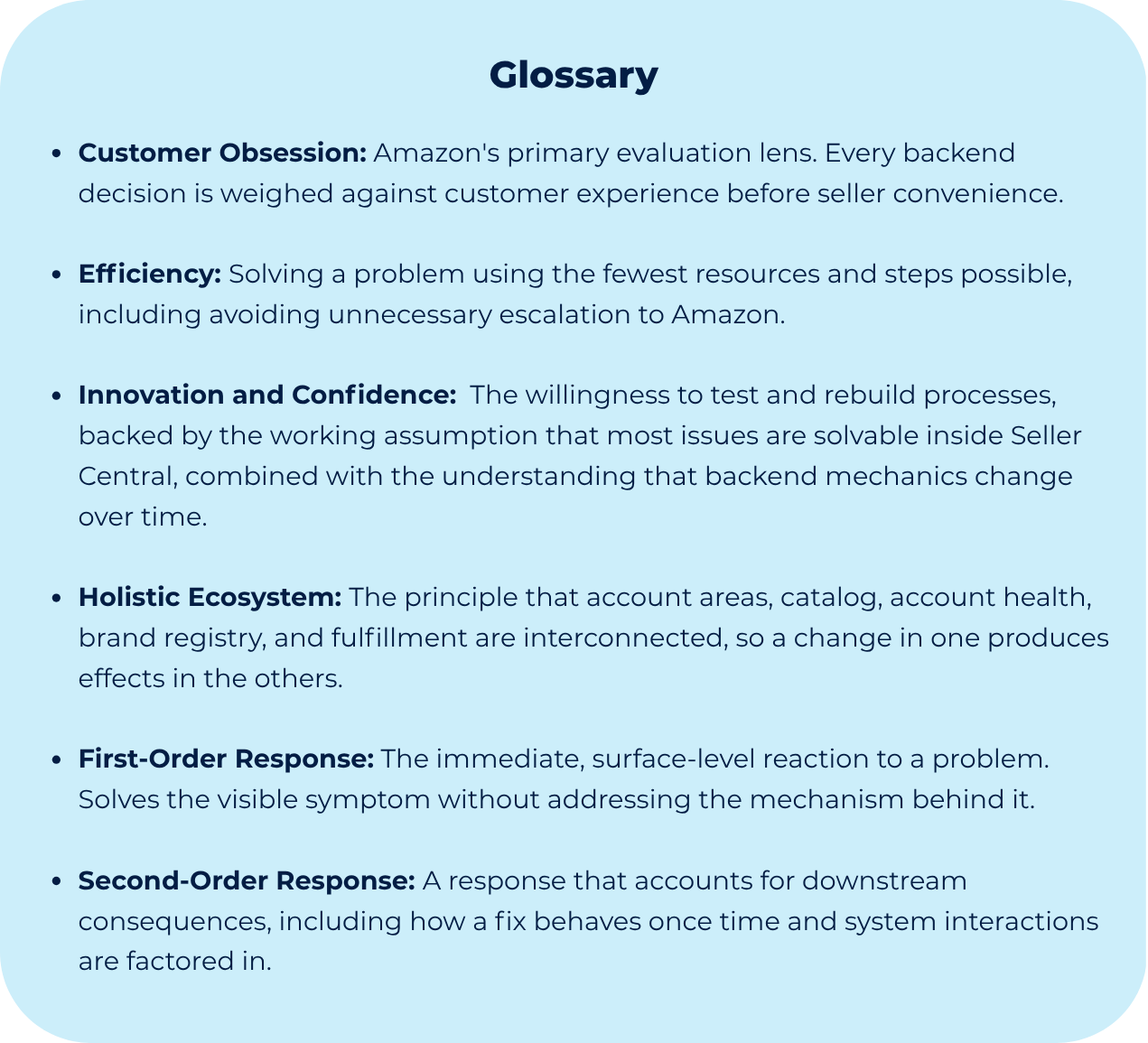
Principle 1: Customer Obsession
Why the seller’s upside is rarely Amazon’s first question
Customer Obsession is not just a mental model we apply, it is Amazon’s own stated mission, and it is the actual reason behind most of the platform-level decisions that end up affecting sellers.
As an operator, the instinct is often to ask what grows the account fastest, and that instinct is exactly where most conflicts with Amazon start.
This shows up constantly at the platform level. When, for example, Amazon blocks a supplement listing over a missing compliance document, that is rarely about the seller specifically, it is Amazon protecting the consumer, and by extension protecting itself from liability.
The same logic sits behind changes to policy, to how listings get displayed, to how Alexa for shopping surfaces products, and to countless smaller layout and ranking adjustments. Amazon keeps changing these things to improve the consumer experience, and those changes routinely create new friction for sellers who built their processes around how things used to work.
Take, for example, when a seller is connecting two ASINs into a variation to share reviews and velocity. The seller’s upside is obvious, but the first question is whether this improves the customer experience or just the seller’s numbers. When variations exist mainly to borrow review volume rather than represent a genuine product relationship, Amazon’s systems, and increasingly regulators, treat that as a customer trust issue rather than a merchandising choice.
Most of the friction sellers experience with Amazon comes from this same gap, where the seller is optimizing for growth, and Amazon is evaluating for customer trust.
That is why recognizing that gap before it turns into a case is what separates operators who stay aligned with the platform from operators who spend their time fighting it.
Principle 2: Efficiency
Solving problems before Amazon ever gets involved
Efficiency means, in some cases, solving problems without involving Amazon at all by using flat files, backend tools, and internal resources before opening a case.
But it is important to keep in mind that this principle is less about speed and more about identifying redundancy, cutting the steps that don’t move the resolution forward.
Mental note: before escalating anything, the question worth asking is whether the action is actually efficient, whether five cases were necessary, or whether scaling to another department was the right move at all.
It’s worth being precise here, efficient tends to mean efficient for Amazon’s process, not necessarily for the seller’s timeline, and confusing the two is a common source of frustration.
Cases that move through the fewest necessary steps tend to close faster and stay closed.
If your case involves a catalog conflict, account health flag, or backend rejection that has resisted a straightforward fix, we invite you to reach out to Online Seller Solutions.
Every engagement starts with a diagnostic, which gives you a clear picture of the mechanism behind the issue and, if a path forward exists, a quote for remediation.
Principle 3: Innovation
Testing without waiting for permission
Innovation works when paired with a willingness to test, break, and rebuild processes, and with genuine confidence that most issues can be solved within Seller Central.
Nothing about this platform should feel unsolvable, and that confidence is what allows an operator to try a new approach rather than default to the same escalation path every time.
This confidence is not the same as recklessness, it comes from testing inside a controlled process, reviewing the outcome, and adjusting before scaling that approach across the account.
A new approach to listing suppression, for example, is tested on one ASIN first, not rolled out across the entire catalog, so the outcome can be measured before it is repeated.
This principle also carries a built-in expiration date, and that’s intentional. A process that resolves cases cleanly today will, at some point, change because Amazon’s backend does not stand still. Seller Central today is not the same tool it was a year ago, and it will not be the same tool a year from now. What that means practically is that the SOP that works this month is not a permanent solution, it is the current best answer, and it needs to be re-tested periodically rather than trusted indefinitely.
Operators who treat their current playbook as fixed truth are the ones who get caught off guard when a process stops working without warning. That’s not a sign the process was flawed, it’s a sign the backend moved, and the operator hadn’t re-tested it recently enough to notice.
Principle 4: Holistic Ecosystem
Nothing on Amazon happens in isolation
When I say “Holistic Ecosystem,” I mean that all parts of the account are connected together, which means that you can not move one thing without affecting others. I am not saying you should not move anything, but you have to consider that when you optimize, adjust, or correct something in your catalog, for example, something in the Account Health will be affected one way or another.
To put it in perspective, when a listing gets a policy violation because new copy included a restricted keyword. That single copy change can affect account health performance score, and if the ASIN is enrolled in FBA, the inventory can go stranded. Stranded inventory means continued storage and overstock fees on units that can’t sell, all triggered by a decision that looked contained to the listing itself.
The variation example from Customer Obsession illustrates this same principle from a different angle. Merging ASINs into a variation to borrow review volume is, on the surface, a catalog decision. But if Amazon determines the variation misrepresents the product relationship, the consequence isn’t contained to that listing, it can extend to brand registry privileges, since Amazon is increasingly scrutinizing variations under regulatory pressure around review manipulation.
Making a catalog-level choice become an account-level risk, and the seller who only evaluated it as a catalog decision never saw that connection coming.
This is also why isolated fixes so often create new problems elsewhere. Resolving an account health flag by suppressing a listing, for instance, can look like the case closing successfully, while quietly reducing conversion on an ASIN that was performing well, which then shows up weeks later as a different kind of issue entirely. Nothing on this platform happens in isolation, and treating any single change as contained is where most avoidable damage comes from.
Putting it all together
First-Principles Thinking and Second-Order Thinking, applied
The four principles describe what Amazon evaluates, but they don’t tell you how to work through a case. That’s where two reasoning tools come in, first-principles thinking and second-order thinking. Together, they turn the four principles from a philosophy into a repeatable diagnostic process.
First-principles thinking strips a case down to what is verifiably true, separating stated Amazon policy from assumptions carried over from past cases. This is what stops a seller from treating this case the same as a similar one that resolved differently, and it’s the tool that supports Customer Obsession and Efficiency directly, since both require seeing the case as it actually is.
Second-order thinking picks up from there, projecting what happens once a fix goes live and which part of the account absorbs that consequence. This is the tool that connects directly to Innovation and Holistic Ecosystem, since testing a new approach or touching one part of the account only holds up if the downstream effect has been accounted for first.
This also comes with a caveat worth internalizing early. What works today may not work in a few months, because Amazon changes its backend constantly. A process that resolves a case cleanly right now can stop working without warning, and that is not a sign the process was wrong, it is a sign the platform moved.
The habit worth building isn’t a checklist to run once, it’s a default posture toward every decision, asking whether it serves the customer, whether it’s the most efficient path, whether it’s worth being confident about testing, and what it sets in motion elsewhere in the account. That posture becomes automatic with repetition, and that repetition is what compounds over time, turning isolated cases into visible patterns and shifting the seller from reacting to the platform to operating within its logic.
“As to methods, there may be a million and then some, but principles are few. The man who grasps principles can successfully select his own methods.”
— Harrington Emerson
See you again next Tuesday.
If you made it this far, thank you for reading and for being part of OSS Lab. These cases exist because of ongoing conversations with operators who are actually inside the system, dealing with real consequences.
If you know someone working in Amazon operations who would benefit from this way of thinking, feel free to forward it.
Helping each other see Amazon more clearly, and avoid unnecessary losses, is the whole point.