

AMZ Essentials #027 - 🛡️ Brand Registry Isn't About Trademarks
Learn how Amazon decides whose edits win, whose edits lose, and why Brand Registry changes the outcome.

If you’re new here, welcome.
If you’ve been reading for a while, thank you for being here.
This edition is a little different.
Alongside our weekly case breakdowns, we’ll occasionally step back and unpack one of the systems behind Amazon.
We’ll explain it the way you would explain it to a teammate, in plain language, focusing on how it works, what it changes inside your account, and how to apply that understanding before problems appear.
All past cases live in a single searchable archive, built to help you identify recurring patterns across time.
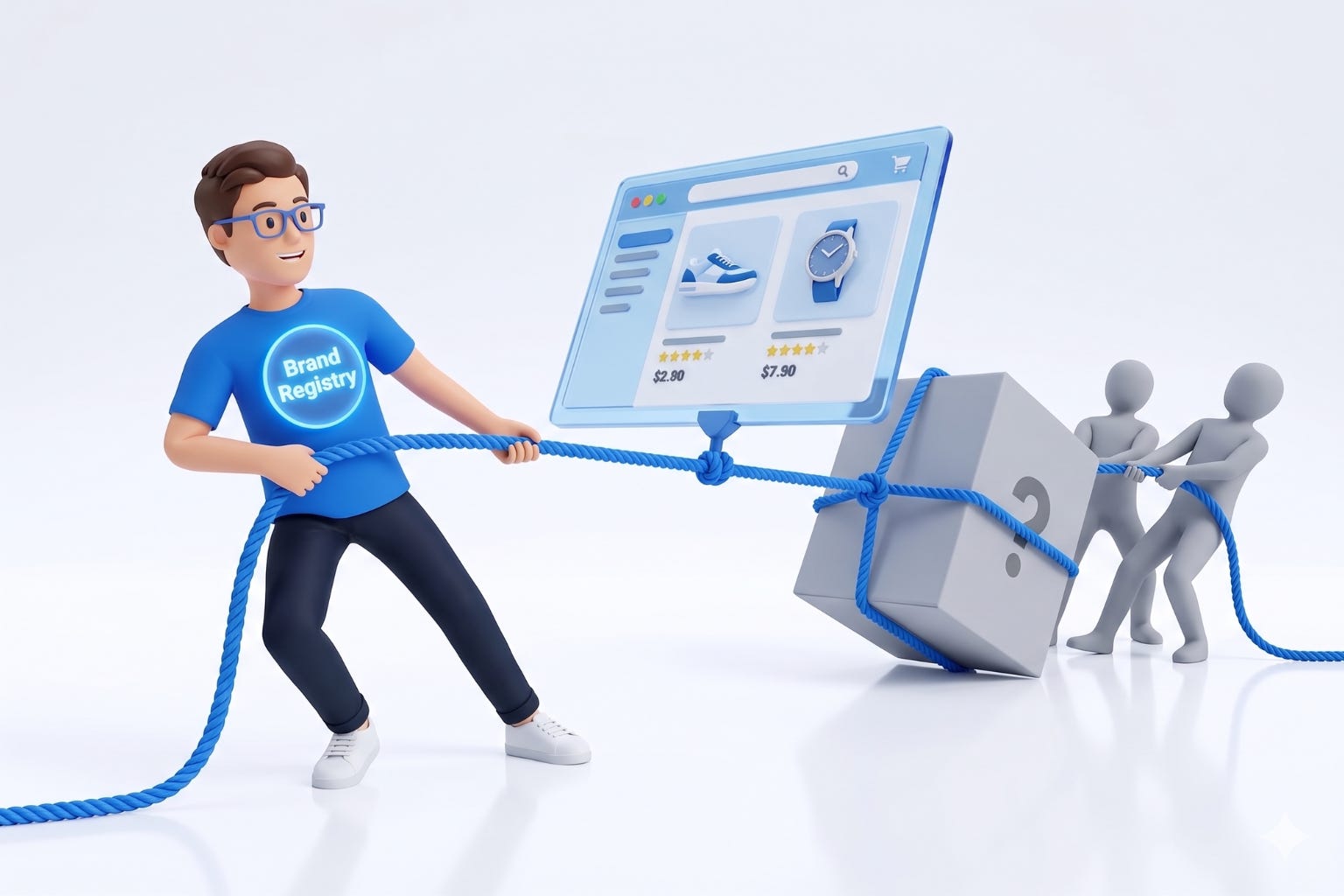
Have you ever tried to fix a simple typo on your own Amazon listing, only to be completely blocked by the system? It is incredibly frustrating to feel like a total stranger to the product catalog and the brand you built from the ground up.
Today’s edition explains why.
The answer sits inside Brand Registry, the system Amazon uses to determine who controls a brand’s catalog record and whose edits the platform is willing to trust.
Context
What’s Brand Registry?
Amazon Brand Registry is a free program that gives brand owners control over how their brand shows up across the Amazon catalog, it works one step up from individual listings, connecting your verified trademark to your brand’s master record, so you can control who makes changes, protect your intellectual property, and unlock brand management tools.
It sits above your individual listings at the account level.
A seller who wants to make catalog edits is first sent through a trademark match check, which has nothing to do with the products themselves.
So what does a seller need to get in?
You qualify when your brand holds an active registered trademark, or a pending application in a supported office, or a pending application through IP Accelerator, in each country where you want to enroll, and you also need to be able to reach the trademark contact, since Amazon sends the verification code to the person listed on the record.
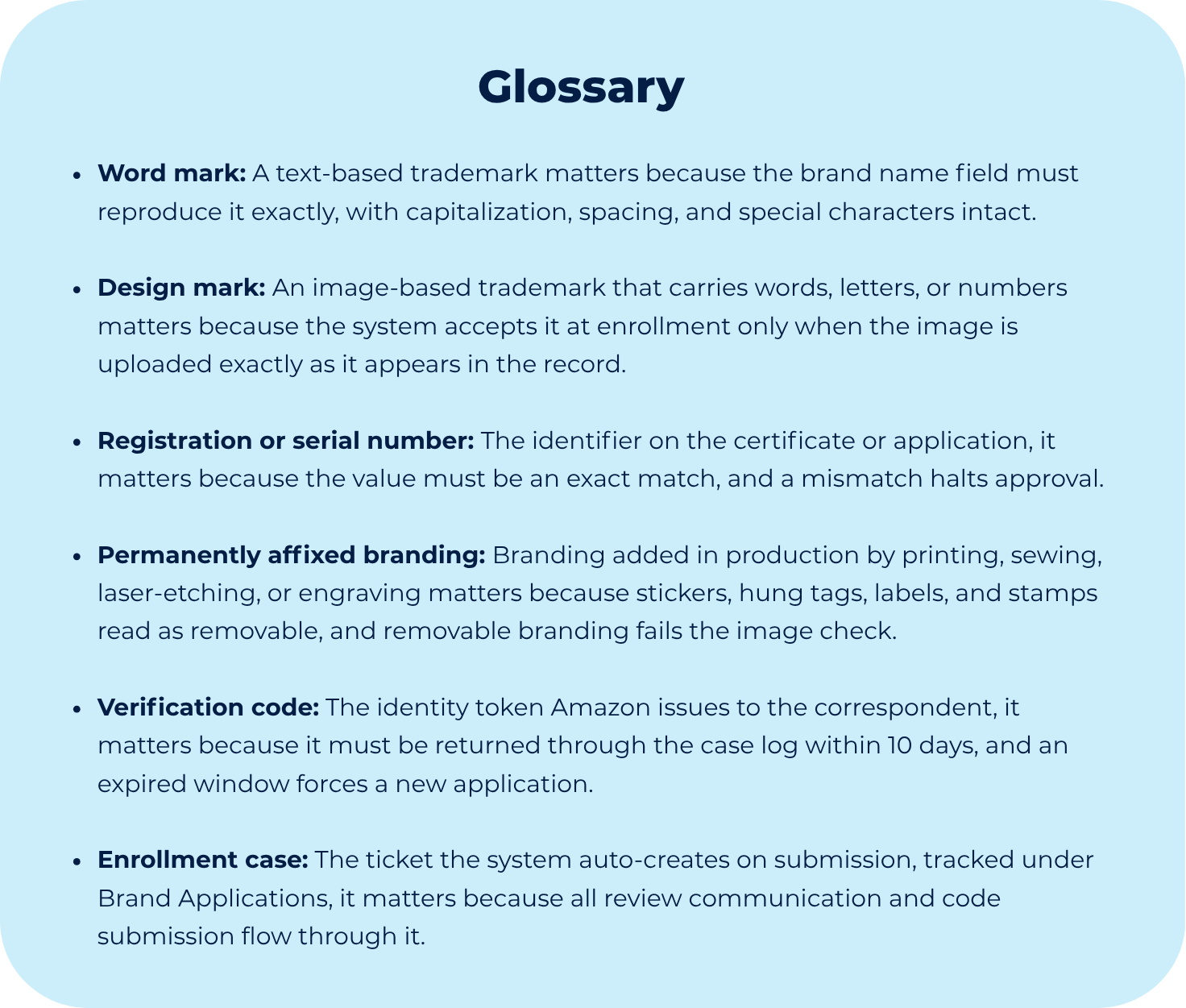
Note: The trademark you submit has to include text that matches your brand name, either a word mark or a logo with words, letters, or numbers in it, text-free logos can be added only after enrollment.
Once you are in, here is what changes at the catalog level.
That connection gives you access to a set of brand management and enforcement tools, like:
The right to edit the master record,
The Report a Violation tool to chase down IP abuse,
And a path into A+ Content, Storefront, and Sponsored Brands
Without enrollment, your account edits the catalog as one voice among many, with little say over the brand record and no access to brand-only tools, with it, your account becomes the trusted owner of that record, and Amazon adds extra protection to the products tied to it
Implication
How Amazon decides whose edits win
That control I mentioned becomes clearer once you understand how Amazon decides whose edits actually win.
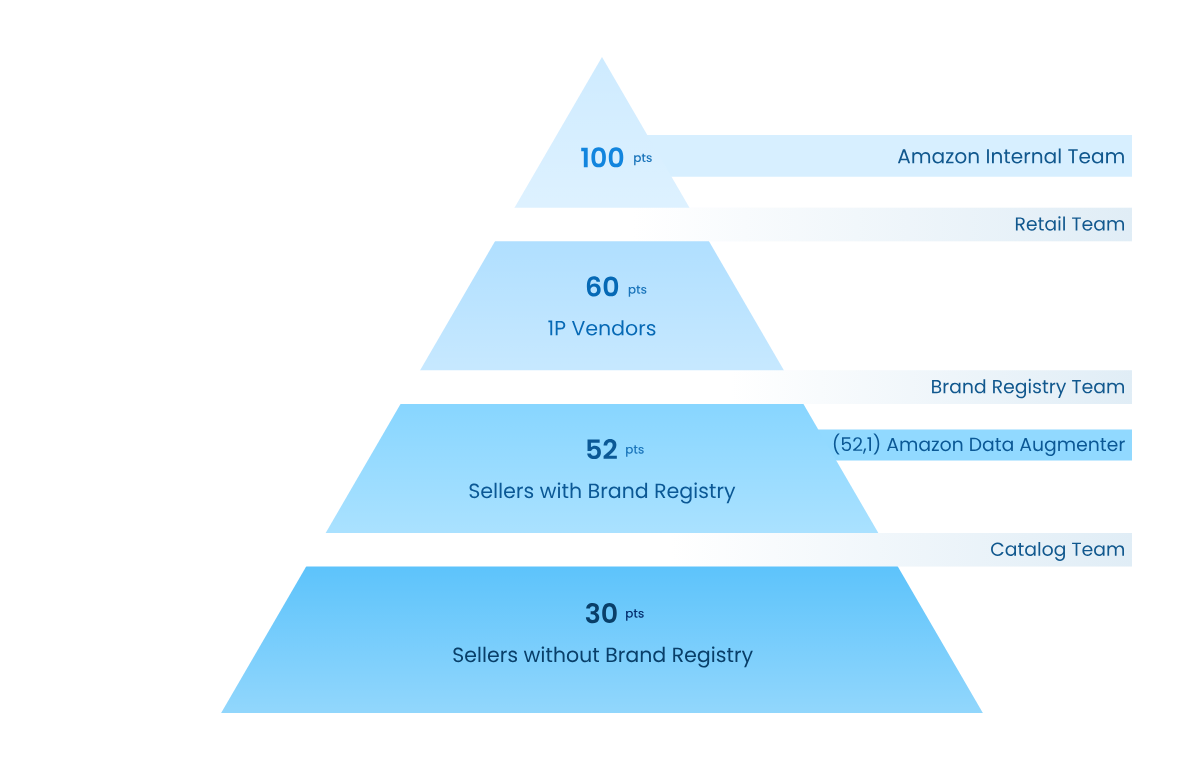
Amazon’s catalog runs on a contribution hierarchy in which every contributor has a score from 0 to 100, and the highest score always wins.
Here is how those scores break down:
30 points, sellers without Brand Registry, with the Catalog Team sitting above them
52 points, sellers with Brand Registry, with the Brand Registry Team sitting above them
52.1 points, the Amazon Data Augmenter
60 points, vendors, with the Retail Team sitting above them
100 points, Amazon internal teams
On Amazon each listing attribute, the title, the brand name, the bullets, and the images, has a single authoritative owner.
So when two contributors submit different values for the same field, Amazon resolves the discrepancy based solely on score, taking the higher value and automatically rejecting the other.
Think of your listing as a leaderboard, if you are not the highest score on a field, you are locked out of it.
This is why the jump matters, enrolling lifts you from 30 to 52, and that climb is what puts your edits above the open catalog, the points you earn through Brand Registry are the points that let you protect your business.
Brand Registry only has to be enrolled once, but every detail has to line up. If you’d rather have our team handle the entire enrollment and verification process from start to approval, contact Online Seller Solutions here.
Application
How to enroll without triggering unnecessary rejection
Once we know what this program is about and what it takes for the system to consider you “relevant,” we come to the practical question: if this is the system, how do you actually secure that position without getting stuck along the way?
Have these in place before you submit:
A trademark that is active and registered, or pending in a supported office, or pending through IP Accelerator, in each country you are enrolling. This is the proof of ownership Amazon starts from.
A trademark in word-mark form, or design-mark form with words, letters, or numbers, with text that matches the brand name you will enter.
The brand name ready in its exact form, same capital letters, spaces, and symbols.
The correct trademark office identified, the one where the mark is actually held.
The registration or serial number copied exactly from the certificate or receipt, with word spacing preserved.
Ownership proof that fits your situation, direct ownership, an authorization letter, or a licensee agreement, with the document ready to upload.
At least one product category chosen, plus every category that applies, based on the goods and services listed on the trademark.
At least one real, unedited product photo showing branding built into the item, matching the exact trademark name, in jpg, png, or gif, under 5 MB. This is your proof the product is real.
A recent supply or manufacturing invoice from the last 6 months showing a brand name (pricing could be hidden)
Your relationship with the brand, seller, vendor, or neither, and the 5-character vendor code on hand if you are a vendor.
Access to your trademark contact, so you can get the verification code back within 10 days.
Below The Paywall
You get access to:
• The exact enrollment sequence, with the out-of-order steps that trigger failure flagged
• How the sequence resolves restricted catalog write-access
• The adjacent catalog anomalies this program touches before and after completion
• The entire archive of every premium OSS Lab case study we’ve published, instantly unlocked.
• Additional Amazon system behaviors, enforcement patterns, and operational intelligence we reserve exclusively for OSS Lab members.
